PAKISTAN has to maintain a delicate balance where the geopolitics of the US-Israeli aggression against Iran are concerned. It involves condemning the aggression against Iran, while not castigating America too harshly, and censuring Tehran’s counter-attacks on GCC allies. Perhaps the difficulty of maintaining this balance was revealed at the UN Security Council on Wednesday, where Pakistan supported two competing resolutions linked to Iran.
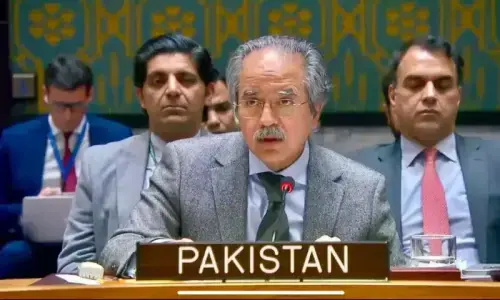
The first, sponsored by Bahrain, criticised “egregious attacks” by Tehran, targeting the Gulf sheikhdoms and Jordan. While the Bahraini document was adopted, a Russian resolution mourning the “tragic loss of life” during the hostilities was not, with the US envoy to the UN accusing Moscow of protecting “its partner Iran”. Defending its support for both resolutions, Pakistan’s UN envoy said the country stands in “complete solidarity” with Gulf states, while adding that the Russian document was backed as it urged a halt to military activities.
It would be morally indefensible for this country to support the US-Israeli aggression against Iran. While Pakistan has criticised the attack, it has been careful with its words, with the rulers unwilling to openly condemn this epic Trumpian misadventure. As for the frequent displays of solidarity with Gulf states, it is for economic, strategic and geopolitical reasons that Pakistan has to express unity with these countries.
It must also be remembered that Pakistan has a mutual defence pact with Saudi Arabia. The prime minister flew to the kingdom yesterday “to exchange views”, while the chief of defence forces visited last week. Clearly, the message from Islamabad is that Riyadh’s defence is a priority for Pakistan. When this pact was signed, many believed that it was to protect the kingdom against Israel, among other threats.
Perhaps the best way for Pakistan to navigate this diplomatic minefield is to push for a ceasefire that ends attacks on all regional states and ensures that the US-Israeli combine are unable to attack Iran and other countries at will. PM Shehbaz Sharif reportedly discussed matters with Iranian President Masoud Pezeshkian recently. According to reports, Mr Pezeshkian said that the international community “must address the main factors behind this imposed war”.
Working with Turkiye and other Muslim states, Pakistan can push for a fresh ceasefire resolution in the UNSC, as the two aforementioned resolutions did not explicitly call for a truce. For any peace plan to work, it must guarantee three things: there must be clear condemnation of regime change attempts in Iran, all attacks on regional states must cease forthwith, and the US and Israel must pledge not to violate the sovereignty of Iran or any other state. If these points are included, the region can start returning to normalcy.
Published in Dawn, March 13th, 2026