UNSC adopts resolution against Iran’s attacks on Gulf nations; Tehran decries ‘blatant misuse’ of Security Council
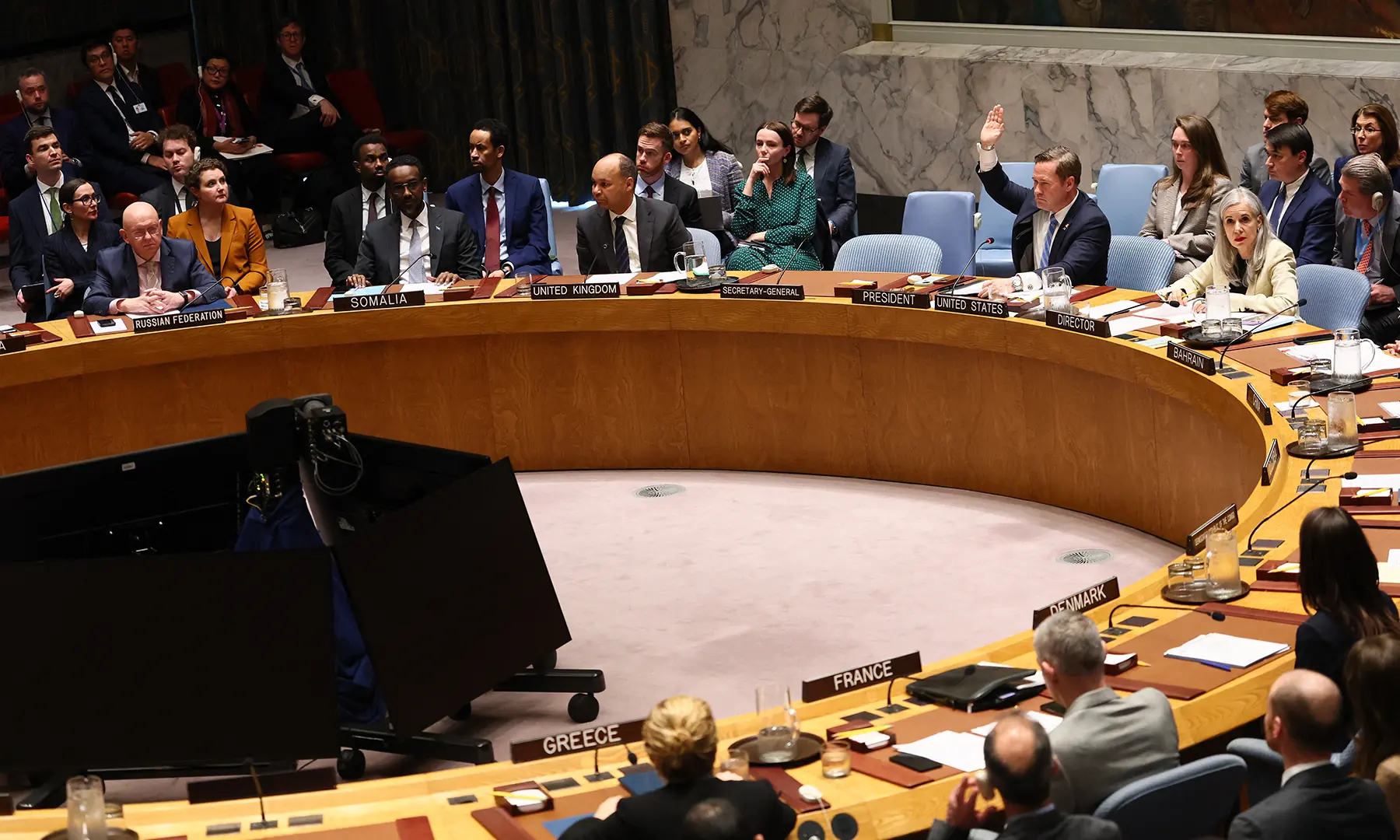


WASHINGTON: The UN Security Council on Wednesday adopted a Bahrain-led resolution condemning Iran’s recent missile and drone attacks on Gulf countries.
The attacks, targeting US assets and bases in Gulf countries, have been carried out in retaliation of America and Israel’s strikes on Iran, which began on February 28 and also resulted in the assassination of Ayotallah Ali Khamenei, who was Iran’s supreme leader.
The resolution at UNSC, drafted on behalf of the Gulf Cooperation Council (GCC), set a record with 135 co-sponsors — surpassing the previous high of 134 for Resolution 2177 (2014) on Ebola.
Pakistan was among the co-sponsors and voted in favour, noting that it is “not immune from these attacks” and stating that it supports the resolution.
The Bahrain-led resolution was adopted with 13 votes in favour; China and Russia abstained.
Its text “condemns in the strongest terms the egregious attacks” carried out by Iran against Bahrain, Kuwait, Oman, Qatar, Saudi Arabia, the United Arab Emirates, and Jordan, emphasising that “such acts constitute a breach of international law and a serious threat to international peace and security”.
It demands the immediate cessation of all attacks by Iran against these countries and underscores the right of individual and collective self-defence as recognised under Article 51 of the UN Charter.
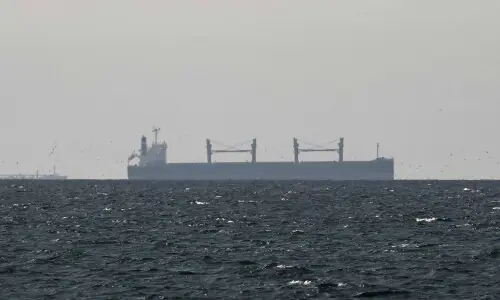
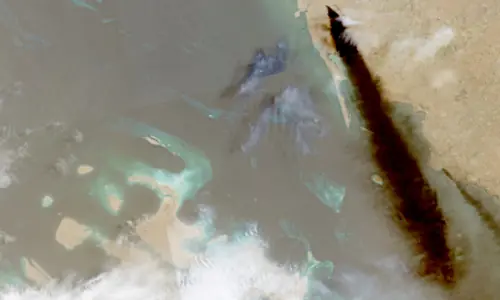
The resolution criticises the “deliberate targeting” of civilians, critical infrastructure, and commercial vessels, including in and around the Strait of Hormuz, highlighting the attacks’ adverse impact on maritime security, international trade, energy supply, and the global economy.
The Security Council also acknowledged the mediation efforts of GCC countries and other regional actors aimed at facilitating dialogue with Iran and resolving disputes peacefully, underscoring the need to prevent further escalation.
In adopting the resolution, the UNSC reaffirmed its commitment to promoting stability and peace in the Middle East, while reiterating support for the sovereignty, territorial integrity, and political independence of the Gulf states and Jordan.
Pakistan calls for ‘swift return to dialogue’
Pakistan’s UN Ambassador Asim Iftikhar Ahmad said the initiation of unwarranted attacks on Iran on February 28 — which Islamabad also condemned — “have seriously jeopardised international peace and security, given rise to grave consequences, and unnecessarily embroiled the entire region”.
At least two Pakistani nationals lost their lives in attacks on the United Arab Emirates, and “millions of other Pakistanis that reside in the Gulf countries remain in harm’s way”, he said, adding that fuel supplies and essential aviation links have also been disrupted.
“We call for a swift return to dialogue and diplomacy to pursue a peaceful resolution,” he added.
French Representative Jerome Bonnafont alleged that Tehran had vastly expanded the war in recent days, saying: “Iran bears a heavy responsibility for the current escalation.”
France, he said, hasdlong been concerned by “Iran’s nuclear threats and its support for regional proxies”.
Ambassador Jamal Fares Alrowaiei of Bahrain, the original mover of the resolution, noted that 135 member states had co-sponsored the text put forward by his delegation on behalf of the GCC.
Emphasising that the Gulf region was a pillar of global security, trade, and economic stability, he said protecting the Middle East was, therefore, in the entire world’s interest.
British Representative James Kariuki highlighted his country’s support for regional defensive operations and said: “It is right that this council wholeheartedly condemns Iran’s attacks, which pose a serious threat and risk further regional conflagration.”
Iran’s ambassador to the UN criticised the resolution as “politically motivated”.
“Today’s action represents a blatant misuse of the Security Council mandate in pursuit of the political agendas of the certain members, the various states responsible for the brutal war of aggression against my country,” Amir Saeid Iravani told the council.
US vetoes Russia’s resolution
Russia also presented a draft resolution on the military escalation in the Middle East at the meeting, but it was vetoed by the US.
The resolution urged all parties to immediately stop their military activities and refrain from further escalation, making de-escalation the central demand of the failed move.
It also condemned attacks on civilians and civilian infrastructure, stressed respect for international law, and encouraged a return to negotiations through political and diplomatic means.
The resolution received four votes in favour — from Russia, China, Somalia, and Pakistan — while the United States and Latvia voted against it.
Nine members abstained from voting, including the United Kingdom, France, Bahrain, Colombia, the Democratic Republic of Congo, Denmark, Greece, Liberia, and Panama.
Lebanon laments being drawn into the conflict
Earlier in the Security Council, Lebanon said it had been drawn into the conflict between Israel and Hezbollah — which continue to target each other during the ongoing conflict in the Middle East — and that it “did not choose” do so.
Lebanese Ambassador Ahmad Arafa said nearly one million people had been displaced amid airstrikes and evacuation warnings. He emphasised that the government had rejected Hezbollah’s March 2 rocket attack on Israel, banned the group’s military activities, and sought to reassert state authority.
Beirut expressed readiness to negotiate a ceasefire under international auspices and called on the international community to support efforts to restore stability.
Pakistan voiced strong support for Lebanon’s sovereignty and condemned Israel’s military actions in southern Lebanon as illegal, urging an immediate halt to hostilities, full Israeli withdrawal, and respect for relevant UNSC resolutions.
Ambassador Usman Jadoon stressed that “dialogue and diplomacy must prevail over confrontation to prevent further regional destabilisation.”
The United States, however, emphasised Israel’s “right to defend itself” against Hezbollah and Iran, while China and Russia called for an immediate ceasefire.
For his part, French Ambassador Bonnafont highlighted the heavy toll on civilians and urged both sides to respect Lebanon’s sovereignty and protect civilians.
Additional input from AFP