Pakistan maintains delicate balancing act in UNSC meeting on Iran


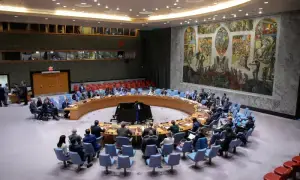
UNITED NATIONS: Pakistan struck a delicate balance at a tense UN Security Council meeting on Saturday, condemning unwarranted attacks on Iran, expressing solidarity with Gulf states, and urging an immediate return to negotiations and diplomacy.
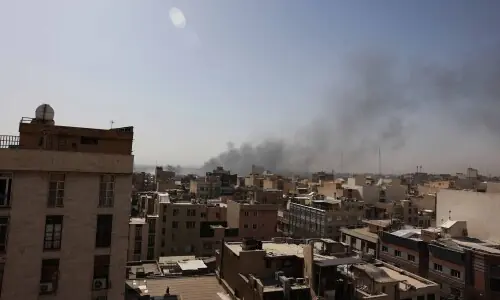
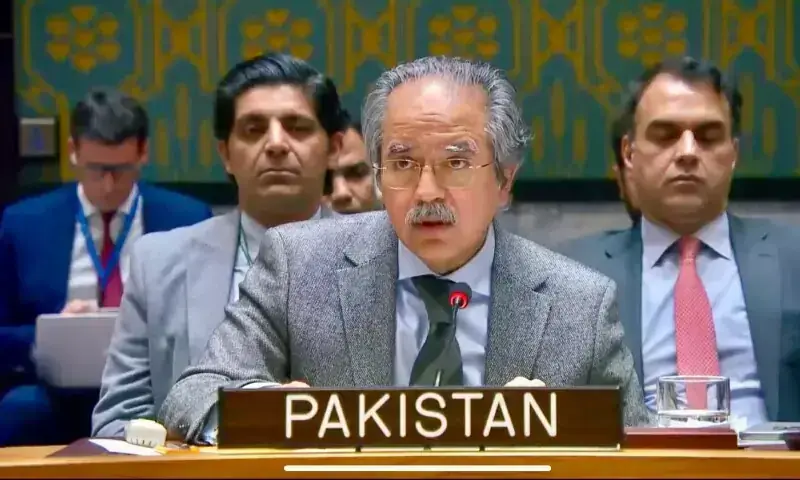
The Council’s emergency session examined the repercussions of the US and Israeli air strikes on Iran and laid bare the deep divisions within the 15-member body over the escalating crisis. Speaking at the meeting, Pakistan’s Permanent Representative, Ambassador Asim Iftikhar Ahmad, outlined Islamabad’s growing concern as the situation in the Middle East becomes more complex with each new development.
“Pakistan condemns the initiation of unwarranted attacks against the Islamic Republic of Iran, in violation of international law,” the ambassador said.
At the same time, he stressed that Pakistan also “condemns the attacks against the Kingdom of Saudi Arabia, Bahrain, Jordan, Kuwait, Qatar and the United Arab Emirates, and stands in solidarity with all these brotherly countries.”
He warned that, at a time when renewed diplomatic efforts were underway, such actions would “undermine the peace and stability of the entire region, with far-reaching consequences.”
Ambassador Ahmad made clear that Pakistan’s concern extends beyond any single capital. Instead, it is focused on the security architecture of the entire Gulf region — home to millions of Pakistani expatriates and a region with which Islamabad maintains deep political, economic and security ties.
This dual condemnation — of strikes on Iran and of attacks on Gulf states — illustrates the fine line Pakistan is walking. It cannot afford to alienate Tehran, a neighbor with whom it shares a sensitive border and a complex security equation. Nor can it distance itself from Gulf partners that host large Pakistani communities and play a critical role in Pakistan’s economy.
The envoy’s emphasis on mediation and dialogue further underscored this balancing act. “We particularly laud Oman’s role in facilitating and mediating dialogue between Iran and the United States,” he said, aligning Pakistan firmly with diplomatic efforts rather than military blocs.
In another pointed observation, he lamented that “diplomacy has once again been derailed as these attacks have happened right in the middle of negotiations,” warning that “these military actions undermine dialogue and further erode trust that was already in short supply.”
Islamabad’s legal framing was equally deliberate. The ambassador reminded the Council that “the purposes and principles of the United Nations Charter are inviolable and sacrosanct,” stressing that the Charter “prohibits the threat or use of force against the territorial integrity or political independence of states.”
This formulation allows Pakistan to oppose unilateral or pre-emptive military actions without directly isolating any particular power beyond the immediate incidents.
At the humanitarian level, Pakistan sought to humanise the crisis. Ambassador Ahmad offered condolences to “civilians caught in the middle of these violent acts,” specifically mentioning “school children in Iran” and the family of a Pakistani national killed in the United Arab Emirates. In doing so, Islamabad reinforced its message that ordinary people — Iranians, Arabs and Pakistanis alike — are the real victims of escalation.
The strategic anxiety was also explicit. “We are deeply alarmed at the risk of regional conflagration,” the ambassador said, noting that the “safety and well-being of millions of our compatriots in the countries of the region is also our top priority.”
Ultimately, Pakistan’s message was straightforward but urgent: “Pakistan calls on all sides to immediately halt escalation and urgently resume diplomacy with a view to achieving a peaceful, negotiated resolution to the crisis.”
Whether the balance Islamabad seeks to maintain can endure will depend not only on its own diplomatic agility, but also on whether the region itself steps back from the brink.