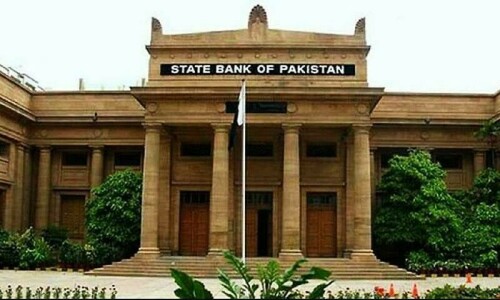
THE State Bank’s decision to pause its monetary easing cycle, after six consecutive cuts of 1,000bps in its key policy interest rate since June to 12pc, in spite of a bigger than expected drop in inflation last month, reflects its efforts to achieve a balance between emerging strains on the economy and the fragile macro stability.
Though CPI inflation is down to just 1.4pc because of declining food and energy prices, the “inherent volatility” in these prices poses significant risks to the current downward trend going forward. In addition, the sticky core inflation remains elevated. This means a halt in the monetary easing cycle is necessary to beat it down and counter the impact of a potential rebound in food and energy prices.
The external account has also come under pressure of late because of shrinking financial inflows and rising imports due to an uptick in economic activity amid growth in private sector credit. The current account deficit of around $0.4bn in January hacked away at the surplus of just above $1bn accumulated over the past several months with the help of rising remittances.
The current account is being used to make foreign debt payments due to weakening private and official capital flows into the financial account. The exchange rate remains stable but the international reserves accumulated in the last eight months have dropped slightly on account of debt payments due to a delay in some of the planned inflows, which may come through after the IMF review of its $7bn programme. Foreign debt repayments of $3bn, the net of rolled-over and refinanced loans, are yet to be made during the remaining period of FY25. Further, increased global economic uncertainty amid tit-for-tat tariff escalations amounting to a trade war between the major economies has posed a risk to international trade, commodity prices and inflation outlook.
No doubt the economy has come a long way from the edge of default less than two years ago, thanks to the implementation of stabilisation policies under IMF oversight. Key macro indicators have improved. But Pakistan is still not out of the woods. Both the fiscal and external sectors remain under stress, impeding the consolidation of the nascent recovery and the economy’s movement towards faster growth.
While the fiscal sector is suffering due to lack of reforms to broaden the tax net, with FBR due to miss the fiscal year’s tax target of Rs12.97tr by a big margin, foreign private and official flows have nearly halted. The global uncertainty caused by a steep hike in US tariffs has set off new disturbing forces. Without large, sustainable foreign capital inflows and structural tax reforms, the State Bank will continue to find it difficult to ease monetary policy without risking another deeper balance-of-payments crisis.
Published in Dawn, March 12th, 2025