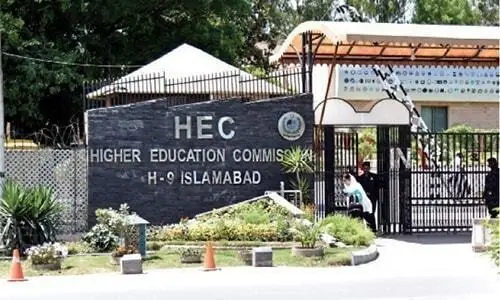
ISLAMABAD: The Higher Education Commission (HEC) on Wednesday directed all accreditation councils to ensure that their standards, guidelines and accreditation criteria are fully aligned with HEC policies.
“This includes ensuring that provisions concerning faculty qualifications, experience and research publications remain consistent with the criteria prescribed by the HEC to preserve national uniformity,” said a press release issued by the commission.
The HEC reaffirmed its role as the sole national authority mandated to develop, notify and maintain the regulatory framework for higher education, including the National Qualifications Framework (NQF), curriculum development and faculty standards.
In a letter addressed to chairpersons and heads of all accreditation councils, the commission emphasised that while discipline-specific bodies play a vital role in undergraduate programme accreditation and professional standards, the overarching policy and regulatory framework remains the exclusive prerogative of the HEC under the provisions of the HEC Ordinance 2002.
“The communication clarifies that the accreditation councils operate strictly within the broader framework established by the HEC,” the press release stated.
It added that the commission retains exclusive authority over system-level regulatory matters, including, formulating and notifying national standards and policies for higher education in Pakistan, prescribing minimum criteria and standards for academic programmes and qualifications offered by higher education institutions (HEIs) and developing academic policies and curricula for all programmes and disciplines.
A key clarification in the directive concerns advanced academic programmes. Citing the Graduate Education Policy (GEP-2023), the HEC stated that programmes at Level-7 (MPhil/MS/Master’s or equivalent) and Level-8 (doctoral/PhD) fall directly within its academic regulatory mandate.
“As these programmes are research-based, the formulation of policies regarding faculty eligibility, supervisory requirements, and quality standards is the exclusive right of the commission,” the press release said.
To strengthen coordination and coherence in the higher education sector, the HEC also highlighted the implementation of the Pakistan Precepts, Standards and Guidelines (PSG-2023), an internationally benchmarked framework integrating institutional governance, learning outcomes, research quality, and accreditation oversight.
Additionally, the Reviewing and Effectiveness of Quality Assurance and Accreditation Bodies (REQAAB) framework has been operationalised to regulate and standardise accreditation councils through mandatory self-assessment and external review.
The directive was issued to a range of councils, including the Pakistan Engineering Council (PEC), Pakistan Medical and Dental Council (PMDC), Pharmacy Council, Pakistan Bar Council (PBC), and education accreditation bodies such as the National Accreditation Council for Teacher Education (NACTE), National Computing Education Accreditation Council (NCEAC) and National Business Education Accreditation Council (NBEAC), among others.
Published in Dawn, March 19th, 2026