Pakistan’s present geoeconomic and geopolitical position appears well placed to benefit from the emerging “non-hegemonic multilateral” world order — this was the core message echoed at the recently concluded Shanghai Cooperation Organisation (SCO) summit.
However, whether the country can consolidate this position in the years ahead will largely depend on two factors: the ability of the political class and the establishment to evolve a new, constitutionally correct and stable decision-making arrangement and how effectively Pakistan addresses its deep-rooted structural economic shortcomings on a sustainable basis.
Currently, Pakistan’s economy presents a complex paradox — displaying tangible signs of recovery while grappling with entrenched structural weaknesses that threaten long-term stability. In FY25, real GDP growth stood around 2.7 per cent, surpassing the 2.4pc of FY24 but falling short of the targeted 3.6pc — reflecting modest yet notable improvement.
Recent indicators suggest the economy is showing resilience, with sustained growth and inflation sharply falling. Inflation averaged 4.6pc in FY25, down dramatically from the double-digit highs of 2023 — and far below the peak of 38pc recorded in May that year.
Stabilisation was supported by a steep policy rate cut — from 22 per cent in June 2023 to 11pc in May 2025 — along with exchange rate stability under prudent macroeconomic management backed by the International Monetary Fund (IMF) program.
Fiscal consolidation, though positive for the books, has come at the cost of critical investments in infrastructure, education, and health
One of the most significant achievements has been the dramatic reduction in inflation — from 29.2pc in FY23 to just 4.6pc in FY25 — providing substantial relief to households and businesses within two years.
This decline created space for monetary easing, supporting recovery in consumption and investment. The stability in exchange rates, easing global commodity prices, and appropriately tight monetary policy all contributed to this disinflationary process.
Yet this surface-level calm masks underlying pressures that could quickly reverse the gains. The government continues to rely heavily on borrowing from domestic banks, crowding out private sector credit and limiting investment.
During FY25 alone the federal government’s borrowings from commercial banks totalled Rs5.43 trillion — more than five times the private sector’s credit offtake of Rs1tr — SBP data reveals. While the fiscal deficit narrowed to 5.7pc of GDP in FY25 from 6.8pc in FY24, this improvement was achieved largely through severe development expenditure compression rather than sustainable, inflation-adjusted revenue mobilisation.
Fiscal consolidation, though positive for the books, has come at the cost of critical investments in infrastructure, education, and health — areas vital for human development and long-term competitiveness.
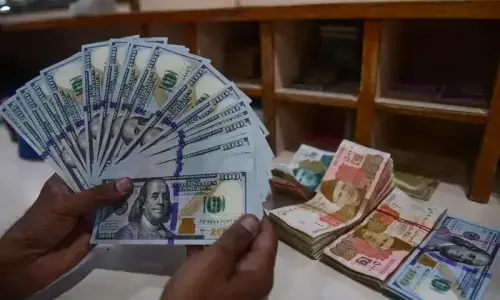
Perhaps the most dramatic turnaround has been in Pakistan’s external accounts. The current account swung to a surplus of $2.1 billion in FY25, reversing a $681 million deficit in FY24. This was driven by robust remittances (up about 31pc), a moderate increase in exports (up 4.7pc) and a lesser-than-usual rise in imports (6.6pc) due to slow economic growth and import-contracting tariff and non-tariff measures.
Despite that, Pakistan’s export competitiveness remains constrained. The export basket is still undiversified and dominated by low-value goods. Infrastructure deficiencies, regulatory hurdles, and high energy costs continue to limit manufacturing potential.
Meanwhile, external debt remains heavy, with servicing costs consuming a large share of government revenue. Since the recent import liberalisation in July, the merchandise trade deficit has already expanded 29pc year-on-year to $6bn as exports remained stagnant and imports shot up, data from the Pakistan Bureau of Statistics show.
A significant breakthrough, however, has been made in addressing the power sector’s chronic circular debt. By end-March FY25, circular debt stock stood at Rs2.39tr, contained through improved collections and tariff adjustments. However, much of this reduction reflects one-off fiscal disbursements, many originally intended as subsidies to consumers. Without genuine structural reforms — improving Discos’ efficiency, tightening billing and recovery, and enforcing tariff discipline — the circular debt is likely to resurface.
IMF-approved arrangements, including a large Islamic finance facility, are expected to smooth financial flows. But this financial engineering tackles symptoms, not causes. Without reforms — privatisation of distribution, market-based tariffs, and efficiency gains — the circular debt issue will re-emerge once the facility is exhausted.
Perhaps the most significant obstacle to sustaining economic gains is Pakistan’s infrastructure and governance. One of the starkest examples of said issues has come with this year’s monsoon devastation: over 850 lives lost to cloudbursts, torrential rains, and floods, alongside hundreds of billions of rupees in damages to crops, infrastructure, and transport networks.
Pakistan stands at a critical juncture. The stabilisation achieved in FY25 — real growth of 2.7pc, disinflation to 4.6pc, and contained fiscal and external balances — provides a foundation for sustainable growth.
Yet these gains remain fragile and reversible without addressing structural weaknesses. The real challenge is not economic but political and institutional. Pakistan has shown it can implement tough measures under crisis. The challenge now is to sustain momentum with an improved and more inclusive political environment and tough economic reforms.
Published in Dawn, The Business and Finance Weekly, September 8th, 2025