PAKISTAN’S compensation landscape is evolving but remains poorly understood due to limited data, lack of structured studies, employers’ reluctance, and no regulatory push for transparency. This gap enables exploitation, misalignment of skills and jobs, and declining productivity.
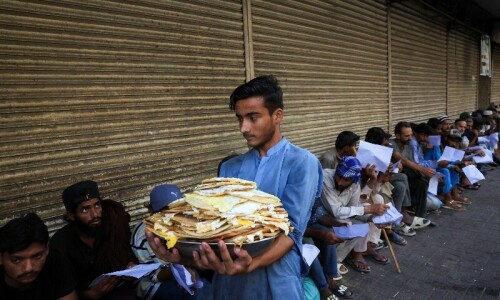
A closer look at Pakistan’s employment scene reveals some stark patterns. About 72 per cent of the workforce (85.18 million) is engaged in the informal economy — underpaid, insecure, and vulnerable to exploitation with little legal protection or bargaining power in a labour-surplus market.
These workers are often the first to face layoffs and salary cuts during cost-cutting. Even among registered firms, there is reluctance to disclose wage bill data. Estimates suggest that wages account for less than 10pc of total operational costs of enterprises in Pakistan, roughly half of the global average, highlighting a structural undervaluation of workers.
Data from multiple sources, corroborated by senior officials, indicates that about 9pc of Pakistan’s workforce is employed in the public sector — federal and provincial governments, including civil servants, office staff, teachers, doctors, and staff in state-owned enterprises.
A similar percentage (around 9pc) works in top-tier formal private companies such as multinationals, tech companies, banks, and export-orientated businesses. Another 10pc are employed by structured but lower-paying firms in the formal sector; the remaining 72pc work in the informal sector, typically in low-paid, insecure jobs with no benefits or legal protection.
This suggests that only about 18pc of the workforce, or roughly 15.3m people, employed in the public sector or elite companies receive decent compensation. The remaining 70m employees are likely underpaid and struggling in harsh and hostile conditions.
The fast-growing, innovation- and competition-driven gig economy now leads all sectors in performance-based earnings. It is followed by elite companies, including banks, top exporters, and multinationals, which offer structured compensation linked to output and results.
The compensation landscape is evolving steadily, but progress is constrained by fragmented data collection, limited digital infrastructure, and weak regulatory enforcement
In contrast, lower-tier public sector employees (Grade 1-16), who make up over 75pc of government staff, enjoy better pay, job security, and post-retirement benefits than their private sector counterparts, despite no correlation with performance.
This advantage disappears at the top. In executive roles, private sector leaders earn significantly more than senior civil servants (Grade 20-22), with generous salaries, bonuses, and perks. Although promotions to top government grades are theoretically performance-based, the system is widely viewed as compromised by nepotism and weak accountability, undermining meritocracy.
When informed about the troubling state of Pakistan’s employment landscape, Federal Labour Minister Chaudhry Salik Hussain, currently on an official visit abroad, responded promptly, expressing concern.
“Pakistan’s compensation landscape is evolving steadily, shaped by inflationary pressures, labour rights advocacy, and global employment trends,” he stated. “However, progress is constrained by fragmented data collection across provinces, limited digital infrastructure, and weak regulatory enforcement, challenges that hinder systematic analysis and policy reform.”
Mr Hussain further emphasised that provincial directorates of labour play a key role in ensuring compliance with labour standards, including wage payments, working hours, overtime, and bonuses, leave entitlements, and occupational safety. “Expanding universal coverage through the Employees’ Old-Age Benefits Institution for pensioner benefits and provincial social security systems for medical coverage could significantly accelerate reform and build a fairer, more equitable compensation framework,” he remarked.
A young labour expert in Islamabad, working for a private company, anonymously shared his insight. He noted that while the formal sector, mainly multinationals and large companies, is gradually adopting performance-based and globally aligned pay structures, the vast informal sector continues to suffer from low, irregular, and undocumented wages.
Although the minimum wage is revised annually, enforcement remains weak. Sharp disparities exist across industries and public and private sectors. High taxation and global competition often lead to cost-cutting at workers’ expense, with minimal focus on well-being, safety, or social protections.
He attributed the lack of salary data to a deep trust deficit among businesses, noting that employers fear regulatory harassment if they share payroll details. “Most workers aren’t on official payrolls, making documentation harder,” he said. Other hurdles include weak enforcement by labour departments, limited inspection capacity, poor digital infrastructure, and employer reluctance driven by fear of compliance burdens.
He noted that in Pakistan, as in many developing countries, vague or complex laws often expand the officials’ discretionary power, increasing opportunities for corruption. Weak implementation, lack of transparency, and manual enforcement create space for rent-seeking. With corruption normalised, many see bribes as a routine shortcut to bypass bureaucratic hurdles.
Majyd Aziz, former president of the Employers Federation of Pakistan, criticised the private sector’s lax attitude towards labour laws. “For most employers, meeting the minimum wage is the only benchmark. While minimum wage boards exist in all provinces, political interference often leads finance ministers to announce wage hikes unilaterally,” he said.
He noted that only about 65pc of formal sector enterprises and less than 10pc in the informal sector actually pay minimum wage. However, export-orientated firms comply due to pressure for international labour and environmental standards from foreign trade partners.
Mr Aziz pointed out that neither the overseas Pakistanis and human resource development ministry nor provincial labour departments have made any serious efforts to collect transparent wage data, even from registered firms. Institutions like the Employers Federation of Pakistan, Federation of Pakistan Chamber of Commerce and Industry, and other labour organisations also lack up-to-date statistics; instead of rigorous inspection, labour departments rely on alternate, less effective measures, resulting in a lack of real-time data.
In Pakistan, labour market reforms are primarily the responsibility of provincial governments following the 18th Amendment in 2010. The federal government retains a limited role, mainly in international labour standards and trade agreements, while provinces lead policy and lawmaking within their domains.
Published in Dawn, The Business and Finance Weekly, July 28th, 2025