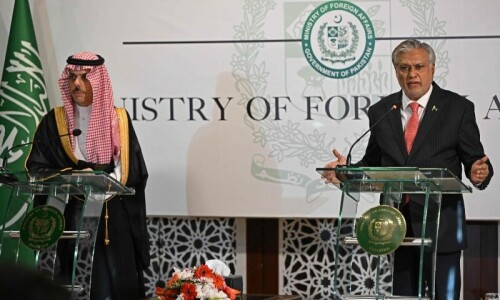
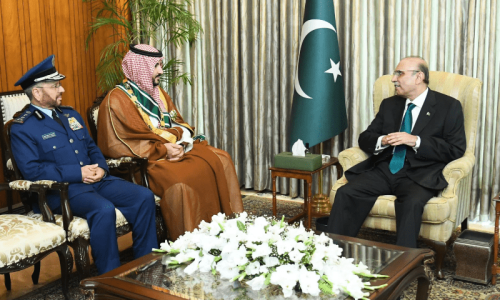
AFTER a two-day stay, Saudi Foreign Minister Faisal bin Farhan, accompanied by a delegation including other ministers, wrapped up on Tuesday what appears to have been a productive visit to Pakistan. The visit is a follow-up to the meeting held between the prime minister and the Saudi crown prince at the end of Ramazan in Makkah.
As expected, economic issues, particularly Saudi Arabia’s investment options in Pakistan, topped the agenda. Prince Faisal met the president and prime minister, sat in on a meeting of the military-backed Special Investment Facilitation Council, and rounded off the trip by addressing a joint presser with his Pakistani counterpart. The prince had encouraging things to say, observing that this country would see “significant benefits” on the economic front soon, while describing his time in Pakistan as “productive”.
Though decades-old and multifaceted, Pakistan-Saudi ties have experienced several ups and downs over the last 10 years or so. For example, Riyadh was not pleased with our decision to stay out of the ruinous war in Yemen. Hindsight shows that parliament made the right decision, as the Saudis themselves are now trying to quietly exit that confrontation with the Houthis.
Furthermore, Imran Khan’s efforts as prime minister to organise an Islamic summit in Malaysia did not go down well with Riyadh, with the Saudis feeling that moves were afoot to create a ‘parallel’ OIC. Mr Khan ended up cancelling his trip to Kuala Lumpur.
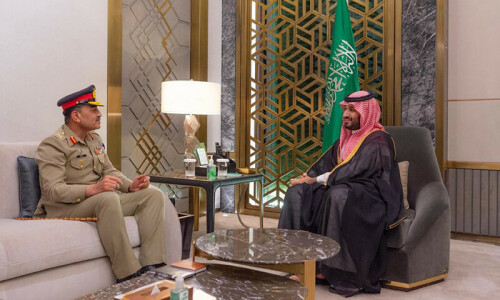
However, things are now seemingly on the mend, as Pakistan seeks to attract billions of dollars in Saudi investment, and the kingdom’s rulers also appear to be willing to forget the hiccups of the past. The Saudi investment programme will likely be launched with full force when Crown Prince Mohammed bin Salman makes his expected visit to Pakistan in the near future.
But our government should no longer expect a free lunch. The Saudis — and others — will be looking to make decent returns on their investments, and for this, there must be political continuity and transparency in our economic policies. Our focus should be on mutually beneficial projects, not handouts.
Interestingly, the Iranian president is also due in Pakistan next week, and the administration has said it is ready to go ahead with the Iran-Pakistan gas pipeline, despite America’s displeasure with the scheme.
The government of Shehbaz Sharif will have to manage a delicate balancing act with Pakistan’s traditional Saudi allies and its Iranian neighbours. Too often, Pakistan has been caught between these two regional giants, though for the most part of our history we have been allied with the Saudi camp.
Pakistan needs to cultivate good relations with both states. In particular, it should boost its economic ties with Riyadh and Tehran, and not get involved in bloc politics.
Published in Dawn, April 17th, 2024