Putin in India on visit seen as tightrope walk for Modi

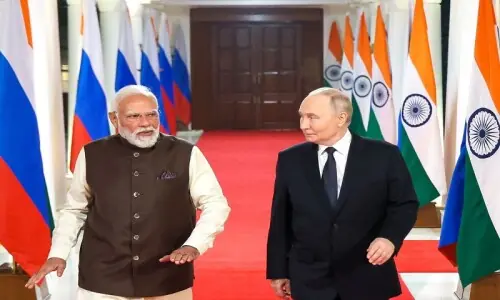
NEW DELHI: Russian President Vladimir Putin arrived in New Delhi for a globally watched strategic visit on Thursday.
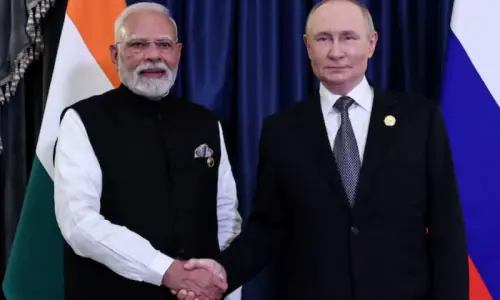
The high-profile two-day dash is being seen as a diplomatic tightrope walk for Indian Prime Minister Narendra Modi, coping with a brusque and demanding US President Donald Trump over India’s ties with Russia, particularly its oil purchases from Moscow.
Mr Modi signalled the importance of the occasion by personally receiving Mr Putin at the airport, though he also continued to breach a long held protocol by denying the Russian head of state a meeting with India’s opposition leaders.
To Rahul Gandhi, leader of opposition in the Lok Sabha, Mr Modi’s decision to not allow him a meeting with Mr Putin indicated the government’s “insecurity”. Given that three European ambassadors had published a strong critique of Mr Putin in Indian newspapers in the run up to the visit last week, there evidently was a strong need for Mr Modi to keep the talks close to his chest.
This would be the first visit to India by Mr Putin since the war in Ukraine began in 2022, and “is not without some anxious moments for New Delhi,” said The Hindu. “The government manages a tense tightrope walk between Russia and Western countries, particularly Europe, on a number of issues including the optics of the visit, oil imports and trade, defence, nuclear cooperation and a mobility agreement.”
The visit was earlier slated for January this year, and the Russian side had announced it in October 2024. Then it curiously disappeared from the radar evidently in deference to Mr Modi’s proximity to Mr Trump. When that relationship soured, however, Mr Modi found himself clasping the only stable hand available.
While high-grade defence purchases have been pencilled for the talks, an unusual centre-piece of Mr Putin’s visit is the dire need for Russia to find skilled labour for his country that has put much of its manpower in the debilitating Ukraine war.
The India-Russia labour mobility agreement to be launched as the “centrepiece” of the visit on Friday, will also be crucial for Indian skilled and semi-skilled workers, who are seeking jobs as other Western markets tighten immigration controls.
According to The Hindu a war-weary and heavily-sanctioned Russia is facing a labour shortfall of what is estimated to be about 3.1 million jobs by the end of the decade. Russia is seeking Indian workers in construction, technology and manufacturing sectors.
A controversy over an editorial piece written by the envoys of France, Germany and the United Kingdom to India criticising Mr Putin over the war and accusing him of delaying peace talks stalks Mr Modi. Indian officials tamely said the editorials were unacceptable.
On the other hand, New Delhi is expecting to host German Chancellor Friedrich Merz in early January, followed by EU’s top leadership Ursula Von Der Leyen and Antonio Costa as guests for Republic Day, and hopes to finalise the EU-India FTA at the EU-India Leaders’ Summit at that time. Given the circumstances, the Indian government could only lean on Russian Ambassador Denis Alipov writing a rebuttal piece the next day.
Russian oil remains a key component of the visit. After a leap in India’s oil purchases, which went from less than 2 per cent before the war, to 40pc last year, India is now drastically curtailing import of Russian oil. Russian sources have said the reduction was expected to be temporary amid reports that the Ukraine war could be coming to an end under the twin pressure of Mr Trump’s engagements with Mr Putin and Russia’s widely acknowledged successes in the battlefield.
India had earlier given up on purchasing Iranian and Venezuelan oil. In the final equation, as Mr Putin put it in October, it is India that stands to lose, a whopping 9-10 billion dollars, whether it braves sanctions or gives up on Russian oil.
Published in Dawn, December 5th, 2025