

THE political crisis in KP doesn’t seem to be headed for a quick resolution. And perhaps, Imran Khan is aware of this as is the ‘other side’. The decision to change the chief minister did not come out of the blue. It had been evident for some time that the PTI and Khan were growing disillusioned with Ali Amin Gandapur. And the reasons were many — his ‘failure’ to get any concessions for Khan; allegations of corruption and misgovernance; and unhappiness of the party (leadership as well as workers) with him. The rumours about what he was getting wrong kept growing.
That Khan was aware of this was obvious. More than once he had sent messages for Gandapur to visit him, to discuss governance matters, such as the budget or increasing terrorism within the province. But for some time now, the chief minister had been a no-show at Adiala. He wasn’t getting the permission was the reply from Peshawar.
But it seems that matters came to a head at the recent jalsa in Peshawar. It was a lacklustre affair by some accounts, lending credence to reports of the growing unpopularity of the party in the province and the disillusionment of the workers with the provincial government. Social media footage of participants expressing their anger when Gandapur took to the stage was widely shared. The incident rattled Gandapur who hot-footed it to Adiala, where the doors opened smoothly for him. That he left as abruptly as he had turned up confirmed the rumours that his visit had not gone well. Gandapur left it to Barrister Saif to tell the press how he was still Khan’s blue-eyed boy, though his blistering attack on Aleema Khan later told a different story.
When the announcement came from Adiala about the change of guard, however, the focus was on the growing militancy and the chief minister’s inability to separate his government from the centre’s policy. That this may not be the entire story is also possible. The trial in jail of Khan in the case called Toshakhana 2 continues at breakneck speed and there are few doubts which way it is headed. There are very little chances of relief from the higher courts. It is assumed that after all the convictions have been secured, access to him will become even more limited. In these circumstances, there is little incentive for Khan to let KP cooperate with the centre, especially as the PTI’s rank and file is also unhappy. It could be a case of using one arrow for two targets.
If the new CM chooses the path of resistance it will further complicate KP’s security situation.
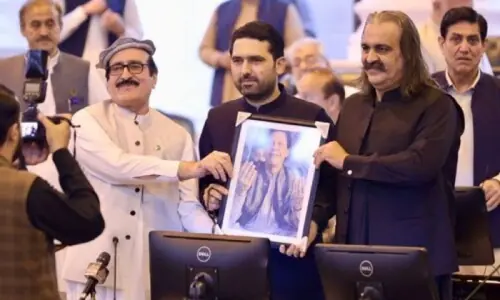
But more than Gandapur’s ‘sacking’, it was the nomination of his successor that upped the temperatures. The party in KP welcomed Sohail Afridi but the rest of the political system reacted differently. The information minister at the centre did a press talk condemning the decision, adding that it would not be allowed. Others from the ruling party gave similar statements, as hushed whispers of governor’s rule or a splintering of the PTI in KP did the rounds. Overnight, the nominee was accused of being an associate of Murad Saeed (one of the few PTI stalwarts still on the run), a Taliban sympathiser, involved in smuggling or worse. The least of his sins and perhaps the only relevant one was his lack of experience. But the criticism against him grew more ludicrous.
The governor continued to throw up legal herrings from not having received the resignation to expressing fears about the authenticity of Gandapur’s signatures. For good measure, he also went and met Maulana Fazl; that they probably did a high five over their local rival’s exit is an image one can only conjure up mentally. The official images were serious and without any outcome.
All of this was also seen in conjunction with the press conference by the DG ISPR in Peshawar. While the talk was about the security situation, politics crept in. It seemed to some that it was aimed at the PTI and its governance in the province and how that was linked to the deteriorating security situation. In this environment, it’s hard to raise questions about the need for such press conferences so let’s just move on to politics.
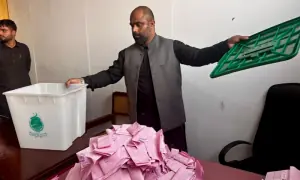
By Monday morning, the election for the new chief minister went ahead far more smoothly than expected. The opposition boycotted the exercise; the number of votes cast for the new chief minister showed the PTI remained intact in the provincial assembly. But none of this indicates a smooth ride from hereon.
As mentioned, Khan, and by extension the PTI, has little incentive to allow smooth cooperation with the centre; this provides no relief to the PTI people behind bars and neither does it help with the growing discontent among KP residents vis-à-vis militancy and military operations.
On the other hand, the establishment is also in a bind. It has not been able to dent Khan’s popularity, especially in KP. But more importantly, it seems for the second time, it has toyed with and abandoned the idea of installing a non-PTI chief minister (for now). This is not simply because of the numbers game; it is more due to the concern over the reaction there.
Unlike Balochistan, the powers that be still worry about the people’s sentiment in KP. While the former can be given a completely puppet government with no legitimate voice, there is less willingness to be this indifferent to public sentiment in KP. This was probably at play in 2024 and might just have been at play in recent days.
But if the new chief minister follows a path of resistance, as he is expected to, it will make the security situation in KP complicated. And if he goes the way of Gandapur, the PTI and Khan will be under pressure again to stir things up. Indeed, short of rapprochement between Khan and the centre, the multiple crises in KP will not witness any change for the better. The province, and by extension the rest of the country, is in for a rough ride.
The writer is a journalist.
Published in Dawn, October 14th, 2025