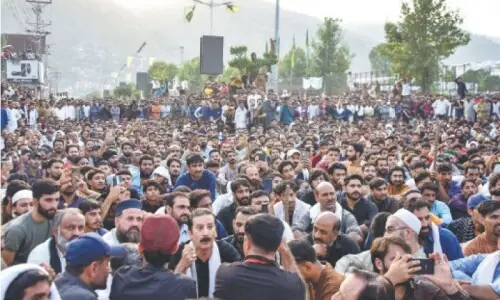
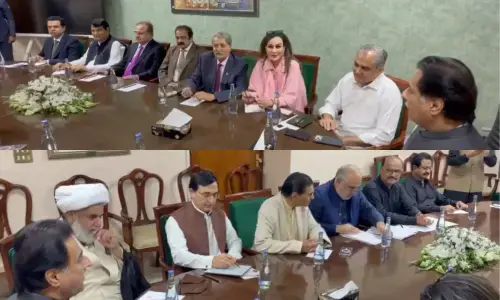
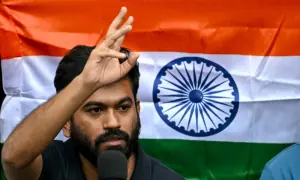
IT was clear that the government would eventually accept the demands of protesters in Azad Kashmir, and re-initiate talks with the Joint Awami Action Committee (JAAC) after the loss of lives and economic and infrastructural damage.
It remains to be seen when and if the promises are fulfilled. Had the government made good progress on earlier demands, the region might have been spared the recent tumult.
In fact, the pattern so far shows that the government, in other parts of the country too, engages in negotiations with protesters merely to pacify the immediate situation, rather than look for permanent solutions to honour its commitments. In some cases, voices of protest fall on deaf ears.
For instance, just days before the JAAC protest, the families of Baloch missing persons once again ended their sit-in and returned from the federal capital. The peaceful families of the missing persons were not fortunate enough to receive even minimal attention from state institutions.
One must move beyond dealing with such situations through force, temporary negotiations and eventual disregard for the demands once ‘normalcy’ is restored. This modus operandi is a relic of colonial times. Many Commonwealth states inherited this pattern, but Pakistan is among the few that appear to have stuck to the old line, without distinction or reform. Regrettably, this is the approach the government took when the JAAC launched its protest this time and earlier in Azad Kashmir.
There have been many protest movements in the country, including the Gilgit-Baltistan Awami Action Committee, the Pashtun Tahaffuz Movement, the Haq Do Tehreek in Gwadar, the Sindhu Bachao Tehreek, and the Baloch Yakjehti Committee. Their demand has been simple: constitutional, economic and political rights, and most importantly, the right to live with dignity. What is common to all such rights movements is that they are essentially anti-elite and challenge entrenched political and economic privileges. The state, however, responds with force against dissent.
The issue of elite capture has come to dominate rights struggles.
Protest can also be seen from a global perspective and applied locally. What took place in Sri Lanka, Bangladesh and Nepal were anti-elite protests that were confronted by state repression. We have seen similar disaffection with elite privileges here as well, its most recent iteration being in AJK.
Yet the authorities in Pakistan, like those in India, have an advantage: the country’s ethnic, racial and religious diversity ensures that movements in the peripheries seldom capture the attention of the mainstream public discourse. The state tends to exploits this by ensuring that such movements remain disconnected from one another and do not reach the heartlands or urban centres where public opinion truly matters.
The recent incident at the National Press Club in Islamabad, where police brutally beat Kashmiri protesters, stormed the premises, and tortured journalists, is part of this same tactic: keeping rights movements, especially peripheral ones, away from the mainstream. The government and state elements not only deploys strong-armed measures but also manipulates narratives on both mainstream and social media. News is censored, and smear campaigns are launched against these movements, which are termed as foreign-funded conspiracies.
Half-page advertisements in the national media and TV screenings by the information ministry have recently been ‘warning’ that a new war is being fought in our minds. They are, in fact, a reflection of the state’s own mindset regarding justifiable dissent, which it reframes by overplaying the theory of hybrid warfare.
Dissenters are tagged as foreign agents and include NGOs, freelancers and media persons who ask critical questions. The public is warned not to share secret information with anyone. It is not certain what kind of sensitive information an ordinary citizen in the country can possess. However, the authorities insist it is a part of narrative warfare and try to create a barrier between areas where the protests take place and the rest of the country.
The recent protests can be seen as a continuation of a rights struggle that began several years ago. The protests were directly linked to promises the state made to the protesters in 2023, pledges that have remained unfulfilled. Meanwhile, the wealthy elite continue to thrive, aligned with power centres in the mainland. Ordinary people believe that privilege and fortune come only through corruption and collusion with these elites, a conviction that fuels their grievances.
The recent deadlock in talks between the government and JAAC, before resumption, centred on the issue of elite capture. Forced by the stalemate, the JAAC proceeded with its protest plan. At the core of JAAC’s 38-point charter was the elimination of elite privileges, especially the 13 reserved seats for Kashmiri refugees. The JAAC views these seats as a source of corruption and political manoeuvring, and thus playing a decisive part in forming governments in AJK.
The comparison with the (former) Fata seats in Pakistan’s parliament is evoked aptly to voice concerns regarding horse-trading and government-making and unmaking at Islamabad’s whim. The government counters that abolishing these seats would weaken Pakistan’s Kashmir case, as India also reserves seats for AJK and GB. It argues that removing them would signal acceptance of India’s Aug 5, 2019, abrogation of Kashmir’s special status.
The JAAC dismisses this claim. It insists that reserved seats have nothing to do with UN resolutions and do not affect Pakistan’s legal stance. Both AJK and GB want constitutional rights as citizens. Instead, critics assert, the state imposes taxes and removes subsidies but does not give them the constitutional cover that would allow citizens to benefit fully, without undermining UN resolutions.
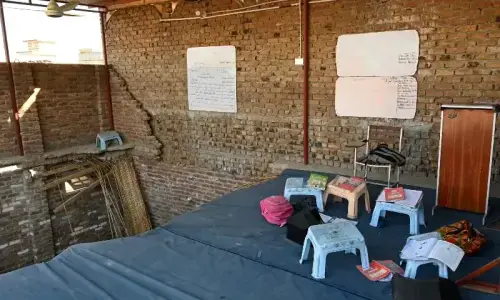
Most of the JAAC’s demands were essentially municipal-level issues, including health, education and sanitation. Yet Pakistan’s ruling elites, particularly in the provinces, have destroyed the local government system, retaining revenues for themselves and spending like monarchs.
The writer is a security analyst.
Published in Dawn, October 5th, 2025