

THERE is no room left now to turn rain-related catastrophes into a political whipping spectacle.
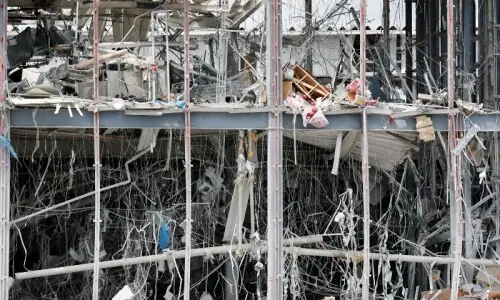
This summer, three provinces controlled by the three major political parties have borne the brunt of a major rain-related emergency, and none is in a position to accuse the other of not having done enough to prepare their province for the calamity.
The clear fact is that Pakistan is facing accelerating climate change impacts and needs to think outside of conventional frameworks in order to build resilience and preparedness. The monsoon is intensifying, glaciers are melting, near catastrophic heatwaves are becoming more and more frequent. This is not political theatre. It is a dire and urgent new reality opening up before us with rising ferocity. The first thing to shed is the reflex to politicise these catastrophes, because that literally does nothing to help.
The three governments — in KP, Punjab and Sindh — have just faced unusually strong rain events. But notice how turning these calamities into opportunities for political point-scoring has backfired spectacularly. When Punjab was inundated in July, for instance, the PTI lawmakers in the provincial assembly held what they called a ‘people’s assembly’ outside the building in protest against the suspension of their colleagues. So far so good. Politics and theatre are cousins after all.
But some among them took the opportunity to skewer the provincial government for the rain-related devastation in the province. Three among them were named in a report carried by this newspaper, and their criticism of the government of Maryam Nawaz took aim at the floods caused by the rains. Crops and farmland were destroyed, they shouted, homes caved in, and “development projects” showcased by the Punjab government were “washed away”. Yet the government “remains indifferent”, according to the report.
There is much that each provincial government needs to do to increase preparedness for the natural disasters hitting the country.
The need and desire of the opposition to protest stridently in Punjab is understandable, given the suspensions that their colleagues have been served. Those that kept the focus on the politics of suppression their party is facing had a clear message. But those that veered and tried to use a natural calamity for political point-scoring were in for a nasty surprise only a few days later when the province run by their own party — KP — was hit by an even larger rain-related calamity.
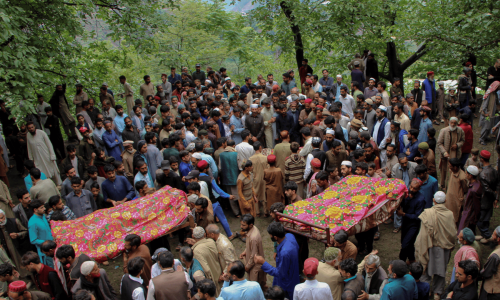
All the criticism they had levelled at the Punjab government was now washed away as the devastation in KP was larger by order of magnitude to what Punjab had seen. If we keep only a political lens when viewing these disasters, who do we blame for the devastation in KP?
Pretty soon, officials from both provinces were bickering over the meaning of the word ‘cloudburst’. Both provinces had ascribed their devastation to a ‘cloudburst’. In Punjab, they pointed to Chakwal, and in KP, they said Buner had seen a ‘cloudburst’. Then the Met Office weighed in, reminding both that the word ‘cloudburst’ refers to a very specific event and no such event had been seen in Chakwal or Buner, and urged them both to refrain from using this word to describe the cause of their respective devastation.
Why this insistence on ‘cloudburst’? Because cloudbursts are nearly impossible to forecast, and attributing rain disaster to them gets officialdom off the hook for having been unprepared. This is why it is now almost routine for provincial governments to use this word when explaining rain-related calamities in their province.
At the time of writing, Karachi is bracing for a second round of intense rain; the first left the city flooded on Tuesday, following more than 200mm of rain in a 12-hour period. The flooding was bad, but the drainage was better. I’m old enough to remember when smaller rain events in 1991 or 2006 left the city flooded for days on end. This time, as in 2020 or 2022, they cleared it within hours. So far, so good.
But the question remains: what prevents faster real-time drainage to keep flooding from become as dire as it does in the first place? The foremost expert on the disaster that is Karachi’s urban planning, Arif Hasan, has a good interview with that intrepid podcaster Shehzad Ghias in which he explains how overdevelopment on three main drainage channels is a major contributor to the flooding.
There is much that each provincial government needs to do to increase preparedness for these disasters that are hitting the country with growing intensity and frequency. And it all begins with superior weather forecasting capabilities. Without this, we are flying blind into a storm.
A former chief meteorologist of the country has an important contribution here. In a report in this paper, he is quoted as saying that Pakistan has 85 automatic weather stations around the country to cover more than 700,000 square kilometres of its land mass. According to the World Meteorological Organisation guidelines, there should be one for every 100 square kilometres of flat terrain, and 50 sq km of hilly terrain. This means we are short by factors of thousands in terms of our ability to monitor threats emanating from the weather.
With this critical weakness we will forever fumble in the dark as the weather turns increasingly hostile. And the resultant calamities will forever be sublimated only through political blaming and point-scoring, getting us nowhere.
A warning sign came around a decade ago when Pakistan experienced five massive floods in five years. Once more, nature is warning that politics alone will not save us.
Three floods in one summer in three provinces controlled by each major political party is a clear enough sign that scoring political points in the middle of natural calamities is the lowest form of politics in the country today. Those who engage in this behaviour are the same as those who in years past tried to score political points via fuel price hikes or exchange rate adjustments. It is time to grow up.
The writer is a business and economy journalist.
Published in Dawn, August 21st, 2025