A sobering climate shock
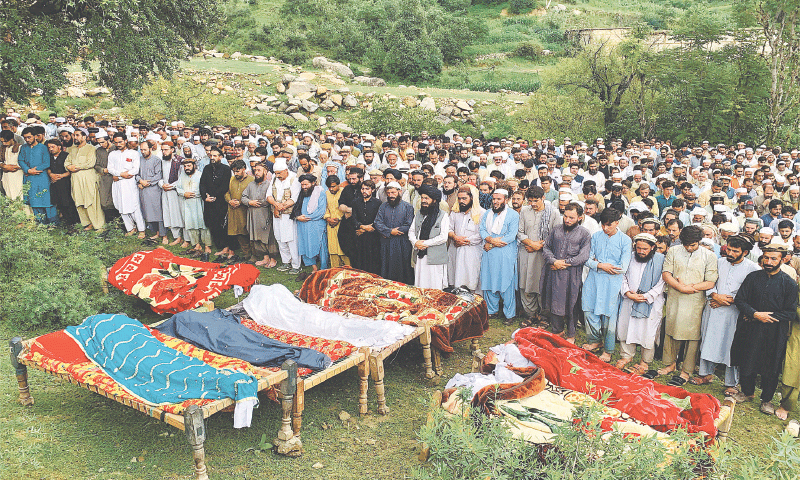

The catastrophic cloudburst in Khyber Pakhtunkhwa on August 15 was not just another monsoon tragedy. It was a stark reminder that when governance fails and resources are distributed unjustly, climate shocks strike with multiplied cruelty.
The official numbers were grim (by Saturday noon): at least 327 lives lost in KP, with 204 in Buner alone, and 12 more in Gilgit-Baltistan. Hundreds remain injured or missing. Pir Baba Bazaar in Buner was swallowed by torrents; livestock and homes disappeared within minutes. The tragic crash of a rescue helicopter — claiming the lives of five dedicated crew members — was a heartbreaking reminder of the risks borne by those who step forward in moments of crisis.
Scientists have long warned that climate change is intensifying rainfall by 10–15 per cent in the Himalayan belt. In Pakistan, unplanned hillside development has destabilised fragile slopes, turning heavy rain into lethal landslides.
But this scientific reality cannot be separated from political negligence. It is not nature alone that devastates; it is the global apathy towards Pakistan’s climate financing needs, coupled with domestic failures to govern wisely, plan sustainably, and allocate resources equitably.
Despite contributing less than 1pc of global carbon emissions, Pakistan remains among the most climate-vulnerable countries in the world. Yet the global community has done little to shield it from escalating climate disasters.
Climate justice without fiscal justice is an illusion
Pledges of climate finance remain slow and inadequate, adaptation funds are scarce, and loss-and-damage commitments are still mired in bureaucracy. The gap between Pakistan’s negligible role in causing the crisis and the disproportionate suffering it bears is stark proof that the world has not done enough to protect it.
Every disaster story in Pakistan betrays the quality of governance — or lack thereof. Poorly regulated construction, weak disaster preparedness, and selective infrastructure spending ensured that when the skies opened up, rural households were left without defence.
KP’s provincial government, much like the federal government, remains more inclined toward funding big-ticket projects rather than investing in disaster risk reduction (DRR).
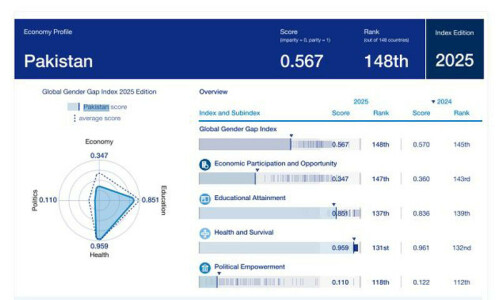
Moreoever, when it comes to women, the bias is institutionalised. If poverty defines vulnerability, governance makes women’s exclusion absolute. Pakistan ranks 148th out of 148 countries on the 2025 Global Gender Gap Index — the very bottom. During the recent flash floods in KP, maternal deaths went uncounted; infant malnutrition spiked. In one village near Daggar, pregnant women were carried on charpoys through waist-deep water, only to find the local clinic destroyed.
Of a Rs291bn federal development portfolio, just 0.2pc is allocated for women-specific projects. Girls’ education and maternal health together receive only 0.57pc. This is not an oversight; it is the direct outcome of governance choices that leave half the population invisible in planning and recovery. Without schools, without clinics, without representation, women remain excluded from the state’s vision of development.
This invisibility persists after disasters. Relief camps rarely account for women’s needs — privacy, healthcare, childcare. And their unpaid labour, already undocumented, doubles in crises. A nation that has not conducted a Time Use Survey since 2007 effectively erases women from the statistics that drive policy. Pakistan’s capacity to respond to climate disasters is further undermined by its fiscal structure.
Despite public support for progressive taxation — 40pc of Pakistanis endorse a general wealth tax — elite capture blocks reform. Still, the Rs14.4bn collected through the capital value tax in FY25 proves redistribution is technically possible. What is lacking is political courage.
Instead, the burden falls on the poor through regressive consumption taxes, even as they bear the brunt of floods, landslides, and disease outbreaks. Climate justice without fiscal justice is an illusion.
The federal budget for FY26 lays bare this contradiction. According to Mettis Global, the development budget for the Environment Division has been slashed by 47pc, falling to Rs3.06bn from last year’s Rs5.78bn. This sharp cut at a time when climate disasters are multiplying shows how environmental survival is treated as expendable. Governance here is not just weak; it is wilfully shortsighted.
Yes, the government has announced Rs500m for KP’s relief. Yes, tourists were rescued from Azad Kashmir. Yes, tents and rations are being distributed. But relief is not reform. Disasters do not flatten inequalities; they deepen them. When schools collapse in Shangla or bridges wash away in Mansehra, children lose education for months, sometimes years. When livestock vanish in Bajaur, households sink into debt. When women lose access to healthcare, maternal mortality spikes. These are not natural outcomes — they are the direct consequences of a governance system that rebuilds without reform.
Resilience demands structural change: land reform to dismantle feudal monopolies; gender-responsive budgeting that puts women’s education and healthcare at the centre of policy; progressive taxation that funds disaster preparedness and equitable infrastructure; and urban planning that dismantles the duality of elite enclaves versus informal settlements.
The silence of policymakers on inequality is as deadly as the silence before a cloudburst. Until that silence is broken, every monsoon will replay the same tragedy — with higher costs, deeper scars, and a widening gulf between those protected by privilege and those abandoned to fate.
Published in Dawn, The Business and Finance Weekly, August 18th, 2025