THE PTI leadership seems to have finally managed to get its leaders in the same room and, for now at least, on the same page.
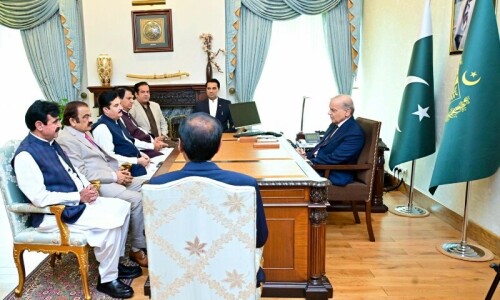
On Wednesday, key figures publicly reaffirmed their loyalty to the party’s jailed chief, sending “a message of strength” to their supporters. The meeting came amidst growing speculation that the KP government may be at risk. “We will defend the KP government at all costs. Anyone attempting a no-confidence motion should first secure the numbers,” PTI chairman Gohar Ali Khan told the media afterwards.
KP Chief Minister Ali Amin Gandapur underlined that his government held a full and legitimate constitutional mandate which cannot be altered without unconstitutional measures. That may be so, but the law has not always proved to be a sufficient check on the government’s ambitions. Perhaps this realisation might have prompted the PTI to close ranks.
There are, of course, lawful means of removing a government. The most straightforward one requires holding a vote of no-confidence and is a prerogative of representatives directly elected by the public.
No one outside the elected House has any business intervening directly or indirectly in such a matter.
This observation follows claims by KP Governor Faisal Karim Kundi that the prime minister had tasked him with leading a regime change campaign.
Mr Kundi on Thursday warned of a looming vote of no-confidence against the KP government even as spokespersons for the federal government issued denials of involvement.
Senator Irfan Siddiqui, for example, stated that “We will not resort to any such tactic that could plunge Khyber Pakhtunkhwa into a crisis.” That seems to be a very reasonable position to take.
The country is still reeling from the economic and sociopolitical fallout of the last ‘regime change’. There is no good reason, therefore, for the powerful to be entertaining ideas about another one.
Prime Minister Shehbaz Sharif’s recent meetings with key individuals from KP had given air to speculation that the federation would like to replace the government in Peshawar with a surrogate; most likely, a coalition of its allies and other provincial stakeholders. The PML-N-led coalition at the centre believes the PTI has ‘failed to deliver’ in the province for over a decade, and ‘failed to protect its people’.
While the party’s achievements, or the lack of them, can certainly be debated, it should be borne in mind that the majority of voters in KP voted the PTI into power, and the electorate’s choice should not be trivialised.
This principle would apply to any party in any province. As uncertainty prevails about the government’s intentions, it is useful to remember that the political and social blowback from any engineered upheaval could destabilise an already volatile region.
Published in Dawn, July 4th, 2025