0
0
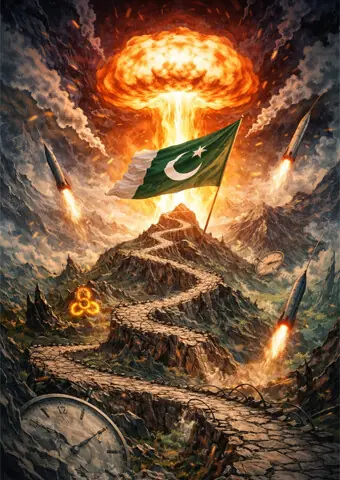
EVEN though there is a ceasefire in place, concerns over escalation between Pakistan and India, the two South Asian nuclear-armed rivals, have been very much there. If the Indian news channels are anything to go by — and, indeed, they are — war hysteria is far from over. In this rather grim scenario, one would do well to consider the possibility of a limited war actually remaining limited.
With temperatures mounting inside India, analysts have not ruled our the possibility of the Indian government doing something that it may later regret, like, say, a so-called surgical strike.
India’s cold start doctrine rests on the notion of limited, punitive strike capability — short in duration, restricted in geography, limited in intensity incursions, and imposing a cost on the adversary without a retaliatory threshold.
Such an approach appears conceptually tied to the theory of escalation dominance, the belief that India can manage, contain and, if necessary, escalate a conflict at will while maintaining strategic advantage.
In practice, however, this assumption is deeply flawed, both strategically and empirically. Strategic reality does not support the Indian assumption that conventional space exists for coercive military action under the obvious nuclear overhang. Pakistan’s full-spectrum deterrence doctrine has been explicitly designed to plug perceived gaps in the escalation ladder.
FSD operates on the logic that even a limited Indian strike, whether kinetic or sub-conventional, is seen as a strategic provocation requiring a calibrated, but firm response. The recent conflict more than proved the viability of the doctrine.
Moreover, experts and history warn against assuming that limited wars can be choreographed in nuclearised environ-ments. Once military means are set in motion, especially when both actors believe that they possess escalation control, the outcomes can quickly escape rational bounds.
Against this backdrop, South Asia exhibits the stability-instability paradox: the presence of nuclear weapons at the strategic level may deter a full-scale war (stability), but it encourages lower-level conflicts (instability) albeit under the nuclear shadow.
Therefore, this framework becomes dangerously unstable if either side begins to believe in controlling escalation through ‘limited’ military options — a belief increasingly visible in India’s doctrinal evolution. Pakistan, in turn, has shown more than once that it will not absorb strikes passively.
The crisis triggered by the Pahalgam incident is not quite over yet. While India may believe in its ability to engage in limited warfare without triggering strategic consequences, Pakistan’s deterrence posture, historical responses, and doctrinal clarity suggest otherwise. The idea that escalation can be neatly managed is an illusion.
The safest and most realistic strategy remains robust diplomatic deterrence, international presence, and meaningful backchannel communications, rather than relying on the fiction that war, once started, can be kept in a box, especially under an undeniable nuclear overhang.
Wardah Rehman
Islamabad
Published in Dawn, June 5th, 2025