I have long delved into the relationship between art and power. It brings up new questions after every new incident, whether at home or abroad, that manifests the use of power — either through socio-psychological oppression or through brute physical force.
Artists of all kinds, including poets, painters, musicians and writers, have challenged, resisted and subverted power since forever. Many filmmakers have also explored this dynamic since the development of the genre of film in the last century. However, not all creative artists challenge power.
Here, something comes to my mind, if I remember correctly, that the ace Iranian scholar and idealogue Ali Shariati articulated well. He derives a concept from the sayings of Imam Ali and describes three classes of people – the mustakbireen [powerful and rich], the mustazafeen [weak and dispossessed] and the ahlul liaqua [knowledgeable and skilled]. What the majority of the knowledgeable and skilled do is to apply their knowledge and skill to increase the power and pelf of the already rich and mighty.
Perhaps, in doing so, they try to fulfil their desire to become a part of those who are socially dominant and wield political power. What the knowledgeable and skilled should do instead, in the light of what the Imam said, is to apply their knowledge and skill to uplift the dispossessed and the weak. That will overturn the status quo and change the balance in favour of egalitarianism, justice and fair play.
In our part of the world, there is a rich history of standing up to power and calling out those who extort and exploit. There are many individuals who kept the flame of resistance to power burning over centuries. However, the more collective and structural response in the modern sense came up after our brush with Marxism and the launch of the Progressive Writers Movement and the Progressive Writers Association that followed in the 1930s and the 1940s.
The loss of a global perspective and a disconnect between artists and workers constitute major losses over the past few decades and overshadow the small positive gain of relegating social realism from the pedestal of a literary celebration.
One must acknowledge that there are many writers who did not become a part of that movement or the association but resisted power in their own way through their work when the movement was at its peak. However, the movement contributed significantly to universalising those struggles for freedom and justice that were waged in different and then unknown parts of the world.
The idea behind the internationalism of the Progressive Writers Movement was to bring the oppressed and the working classes together, irrespective of whichever continent on the planet they lived on. It was a well-meaning project to visualise and treat the larger humanity as one. Besides, it created a relationship between the artist, writer, worker, peasant, journalist and student, to give a voice to the voiceless and to make the invisible visible. Today, we see that, with the weakening of the Progressive Writers Movement, both the internationalism in our quest for justice and that link between artists and workers within our country and elsewhere have been substantially weakened.
With the weakening of the movement, the only positive I see is the end to celebrating social-realism as the only politically correct form of expression by leftists and those leaning towards them. The negatives as mentioned above — the loss of a global perspective and a disconnect between artists and workers — constitute major losses over the past few decades and overshadow the small positive gain of relegating social realism from the pedestal of a literary celebration.
Nothing from the past can be resurrected, but a new beginning is needed, where our artists and writers begin to engage with the struggling classes and understand the existential, social and political issues of humanity at large. The choice of expression remains with the artist.
Let us now come to the absence of our ability to connect local struggles with struggles elsewhere in the world — the loss of internationalism. American civil rights leader Martin Luther King Jr famously said that “injustice anywhere is a threat to justice everywhere.” Progressive writers in our part of the world were already emotionally invested in humanity as a whole before King said that. Therefore, we find Sardar Jafri writing about Korea, Faiz Ahmed Faiz writing about Iran and Palestine, and so many others universalising the suffering that humanity faces in any part of the world – ranging from Vietnam to Chile.
From Ibn-i-Insha to Zahida Hina, a number of writers offered powerful pieces of poetry and prose about those parts of the world which are geographically distant but where human beings like us live and struggle — against issues as diverse as the famines in Africa to nuclear disasters in Japan. This doesn’t seem to be the case anymore.
To borrow terms from the Marxist categories of analysis, purely out of convenience and familiarity, there is a continued unification of capital and profit-making by the few on the one hand and a systematic fragmentation of labour and national struggles around the world on the other. This can only be reversed by creative artists who champion resistance to power.
Artists have to be indiscriminate about their choices of supporting those who struggle for rights in any part of the world. It is important to be rooted in our land but it is equally important to grow a trunk with branches and leaves, and spread in the skies above and provide shade to the land underneath. As much as a tall tree with thick foliage can offer.
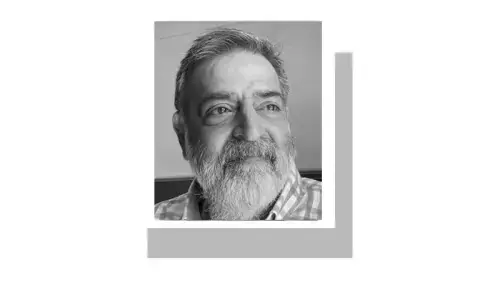
The columnist is a poet and essayist. His latest collections of verse are Hairaa’n Sar-i-Bazaar and No Fortunes to Tell.
Published in Dawn, Books & Authors, June 1st, 2025