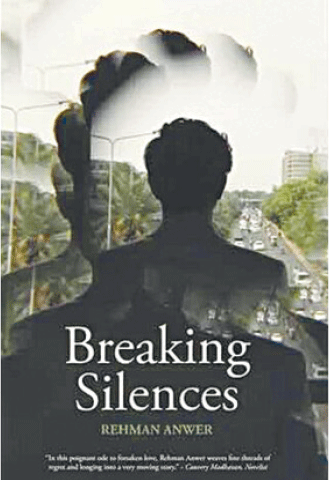
Breaking Silences
By Rehman Anwer
Broken Leg Publications
ISBN: 978-9697736089
50pp.
Known for its compressed narration instead of its commercial appeal, the novella has become something of a pariah in modern-day publishing. The form occupies a clumsy, intermediary space between the short story and the novel. Owing to the misconception that full-length novels sell more than novellas or short story collections, few presses are willing to undertake the risk of venturing into this precarious territory.
Be that as it may, the form carries its own subtle grace. At its core, the novella is a literary architecture rooted in restraint — a category of fiction wherein structural precision and economy hold sway.
In an essay for The New Yorker, titled ‘Some notes on the novella’, British author and screenwriter Ian McEwan billed the form as “the perfect form of prose fiction.” He likened it to “the beautiful daughter of a rambling, bloated, ill-shaven giant… who’s a genius on his best days.” Extolling the virtues of the novella, McEwan believes that it enables writers to achieve perfection and unity in a narrative.
At a time when Anglophone literature from Pakistan is saturated with expansive works of fiction and non-fiction, Rehman Anwer’s novella Breaking Silences emerges as an anomaly. Even as an outlier, this intriguing tale is likely to enjoy a favourable position on account of its brevity.
A debut novella offers a biting critique on the conventional wisdom that views relationships as antidotes to loneliness
Spanning a mere 50 pages, Anwer’s debut work of fiction promises to be a compact narrative — a veritable blessing for readers who flinch at the sight of heavy tomes. Yet, the novella’s deceptively simple premise masks hidden layers of complexity.
Breaking Silences features a fraught reunion between estranged lovers. On a “slow and dreary afternoon”, a grey-haired Wali walks into a cafe in Lahore to meet a woman who was once the focal point of his world. Fittingly named Kainat (the Urdu equivalent for ‘universe’), the latter has arranged this meeting in an earnest effort to seek closure. Steered by a misguided optimism, Kainat hopes the encounter will help the two of them give voice to suppressed emotions and find a doorway to peace. However, this fated afternoon threatens to morph into a delicate dance around old wounds and unforgotten betrayals.
Three years before this meeting, Kainat abandoned him to marry an eligible suitor. Following this dramatic turn in their rose-tinted romance, a searing silence settled between them that steadily deepened into a chasm. Before their relationship tragically ended, Wali and Kainat were bound to each other by a “love [that] came to their lives like spring, short and sweet, filling their lives with daffodils and dreams.”
However, the fervour of that unforgettable spring has ebbed away, leaving a trail of emotional scars. As the novella begins, Kainat and Wali reunite in autumn — a time when fallen leaves are scattered across Lahore’s streets and “resignation [has] replaced the chaos of love.”
Unfortunately, the venue chosen for this meeting is far from neutral. It is the same cafe where the erstwhile lovers met close to a decade ago. Therefore, Wali and Kainat find it challenging to escape the stranglehold of memories and regard each other with fresh eyes.
Their conversation — at once intensely emotional yet measured — inevitably turns to the past. Even as they scrutinise each other’s conduct, the ex-lovers maintain a veneer of civility, as though they are speaking as strangers. While Wali and Kainat pull their punches and avoid a full-blown confrontation with each other, they are propelled by rage that steadily morphs into regret.
Kainat’s contrition takes the shape of a profound sadness over the loss of what could have been. Shackled by the “invisible chains” imposed on her by her family, Kainat decided to forsake her own happiness at the altar of conventions. “Sometimes it’s the sweetest words of your family, your fear of breaking their hearts, or letting them down in front of others, or a combination of all three, that lead you to make your life decisions at the expense of your own happiness,” she tells Wali. Now, as the loneliness of her marital life gnaws at her, Kainat contemplates whether the pursuit of happiness truly amounts to selfishness.
For Wali’s part, regret unfolds in the form of reluctance. He has learnt to live through his “daily routine and some memories of [a] beautiful relationship” with Kainat, but his unwillingness to replace her with another woman reflects his concerns about the sheer futility of love.
In their own distinct ways, Wali and Kainat are victims of circumstance. The former comes through as a “silent sufferer… the storm keeper who would never allow his chaos to impact others around him.” Ironically, he is weighed down by the chaos of the uncaring world he actively sought to shield from his own dilemmas. Kainat, though, emerges as a pale shadow of her old self — a woman defeated not by her own cowardice, but her reluctance to defy social expectations.
Breaking Silences isn’t a novella driven by plot, but a quiet study of these two characters as they come to terms with the insidious ways in which they have been wounded by circumstances beyond their control. Lahore isn’t just the locale where the drama of Wali and Kainat’s lives is staged. On the contrary, its changing infrastructural landscape becomes an abiding metaphor for the gradual deterioration of their bond.
“I miss the old Lahore,” Kainat says during their meandering conversation, “its secrets and mysteries, and most of all, the old us — you and me.”
Anwer’s novella offers a biting critique on the conventional wisdom that views relationships as antidotes to loneliness. The reality, as discerning readers will discover in the pages of this slim volume, is that the self cannot be stifled in the pursuit of love.
Breaking Silences tackles a serious subject with aplomb, but the weightier themes are balanced seamlessly with occasional moments of levity. At one point in the narrative, the conversation drifts towards Wali’s preoccupation with the absurdist and existentialist writers of the 20th century. Wali takes this as a cue to describe the conversations he imagines himself having with great literary giants such as Franz Kafka, Samuel Beckett, Sylvia Plath and Virginia Woolf in “a special corner of hell.”
However, this brief exchange isn’t seeded into the narrative as an afterthought, but as an eerie reminder of Wali’s plight. Beneath the veneer of witty repartee, readers will detect the despondency that haunts him.
The novella reveals the power of having difficult, painful and unpleasant conversations about matters of the heart. Unfortunately, Anwer’s characters struggle to arrive at an optimistic conclusion to the situation. Wali and Kainat are trapped in a shell of self-pity and loathe themselves for the tragic end of their intense romance — a common tendency among those who are hapless in love. Even so, the conversation at the cafe urges them to confront dark, crippling realities about themselves and their conduct in emotionally turbulent relationships.
The strength of Breaking Silences lies in its immersive, accessible prose. Anwer doesn’t resort to melodramatic flourishes and mines some unsettling truths about human relationships with remarkable clarity and precision.
The reviewer is the author of the critically acclaimed novels Typically Tanya and No Funeral for Nazia.
X: @TahaKehar
Published in Dawn, Books & Authors, November 30th, 2025