Pakistan rejects India’s ‘new normal’ claim


• FO says Islamabad’s restrained response reinforces deterrence, warns Pakistan will have no choice but to respond if India resumes hostilities
• Insists govt remains committed to ceasefire
• Indian defence minister signals aggressive stance, calls strikes a ‘trailer’
• Jaishankar reiterates any talks will be strictly bilateral
ISLAMABAD: Pakistan on Friday rejected India’s claim that recent military strikes had established a “new norm” in their tense bilateral relations, insisting that respect for sovereignty and territorial integrity remains the only acceptable standard in inter-state ties.
The remarks by Foreign Office spokesman Shafqat Ali Khan came amid a fragile ceasefire agreed upon on May 10, following India’s Operation Sindoor (vermilion, a traditional symbol of marriage worn by Hindu women) and Pakistani response codenamed Operation Bunyanum Marsoos (Iron Wall).
Pakistan condemned the strikes as a violation of its sovereignty.
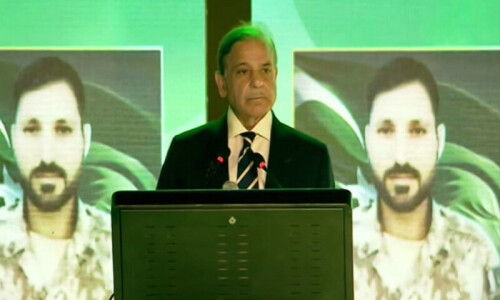
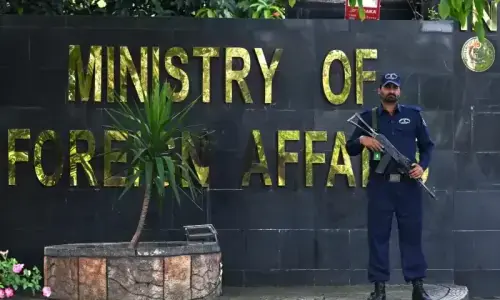
“While India propagates the notion of establishing a ‘new normal’ in bilateral relations, our restrained response has reaffirmed that the only acceptable norm is respect for sovereignty and territorial integrity,” Mr Khan said at the weekly media briefing.
“Pakistan’s effective counterstrikes have reinforced the credibility of its deterrence and dispelled any illusions of India’s conventional superiority or its ambitions to impose hegemony in the region,” he added.
The ceasefire, brokered with US mediation, has held though tenuously.
Mr Khan underscored Pakistan’s commitment, saying, “Pakistan, as a responsible state, remains committed to the ceasefire and to taking necessary steps towards de-escalation and regional stability.”
He warned, “Given India’s belligerent posture, we call upon our international partners to ensure that India honours its commitments and refrains from further aggression. Should India resume hostilities, Pakistan will have no choice but to respond.”
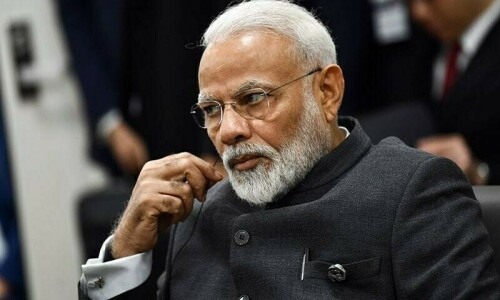
On Friday, Indian Defence Minister Rajnath Singh described the strikes against Pakistan as “just a trailer, will show full picture if need be,” signalling India’s readiness to escalate, according to Indian media.
Tensions were further complicated by China’s announcement to rename 27 places in Arunachal Pradesh, a region India claims as its own. India’s External Affairs Ministry called the move “vain and preposterous,” asserting, “Arunachal Pradesh was, is and will always remain an integral and inalienable part of India.”
The Pakistan Foreign Office spokesman expressed support for Beijing, saying, “We have noted this development regarding China’s renaming of some areas within Arunachal Pradesh. Pakistan reiterates its consistent support for China on issues of its sovereignty and territorial integrity.”
Mr Singh, in his statements, also urged the International Monetary Fund to reconsider $1 billion in aid to Pakistan, alleging it could fund terrorism. “India has consistently maintained a firm and uncompromising stance against terrorism in all its forms and manifestations,” he said at Bhuj Air Base.
Mr Khan dismissed Mr Singh’s statement, stating, “India trying to politicise an institution like the IMF speaks about its desperation and frustration”.
He also criticised India’s suspension of the Indus Waters Treaty, a 1960 agreement governing shared rivers. “Holding the Indus Waters Treaty in abeyance is unilateral and illegal,” Mr Khan said. “It is equivalent to an attack on the people of Pakistan and its economy”.
US Secretary of State Marco Rubio has proposed talks at a neutral venue, but Mr Khan called media discussions on timing and modalities “premature”.
“Professional diplomats are optimists; we are optimistic people. The government remains optimistic,” the spokesman maintained.
India’s External Affairs Minister S. Jaishankar on Friday insisted talks would be “strictly bilateral”, signalling resistance to third-party mediation.
Published in Dawn, May 17th, 2025