In consolidation act, army chief dons another hat


 2
2
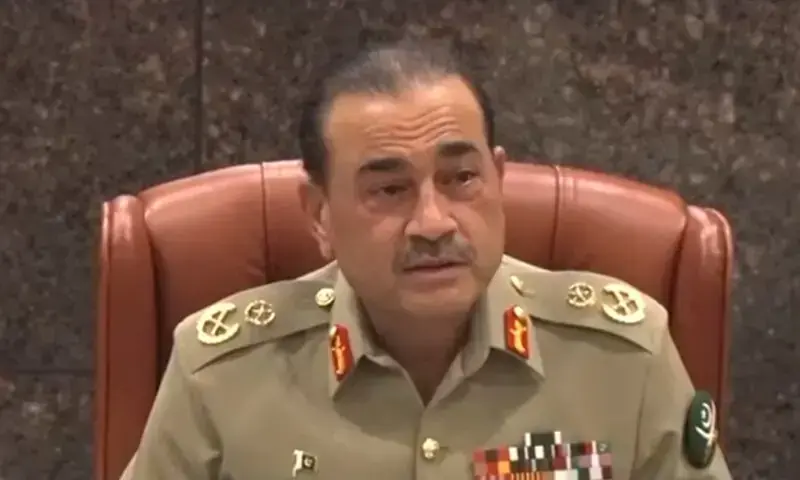

• On PM’s advice, president okays Field Marshal Munir’s appointment as country’s first chief of defence forces
• New role consolidates operational, administrative, strategic authority in single office
• ‘CDF-cum-COAS’ five-year term to run until 2030, with possibility of extension
• Defence ministry finalising organogram for new position, says law minister
ISLAMABAD: Field Marshal Asim Munir was named the country’s first chief of defence forces (CDF) on Thursday, in the most sweeping restructuring of the military command since the 1970s.
The announcement came after the president approved the appointment, on the advice of PM Shehbaz Sharif.
“President Asif Ali Zardari approved the appointment of Field Marshal Syed Asim Munir as COAS concurrently as CDF for five years,” the Presidency said in a statement, formally ending days of speculation over the delay in notification.
Earlier in the evening, PM Shehbaz had advised the president to appoint Field Marshal Munir to the newly created, dual-hatted office.
“The prime minister has forwarded to the Presidency the summary approving the appointment of Field Marshal Syed Asim Munir as Chief of the Army Staff and Chief of Defence Forces,” the Prime Minister’s Office said.
The new arrangement consolidates operational, administrative and strategic authority in a single office established through amendments to Article 243 of the Constitution under the 27th Amendment.
The revised Article 243 provides that the president, acting on the prime minister’s advice, shall appoint the chief of the army staff, who will concurrently serve as the chief of defence forces.
The amendment also abolished the office of chairman joint chiefs of staff committee (CJCSC), dismantling the tri-service coordination system in place since 1976 and transferring joint command integration to the CDF.
Five-year tenure reset
To translate the constitutional overhaul into the military’s legal framework, the government amended the Pakistan Army Act (PAA) of 1952 in the wake of the 27th Amendment.
Sub-section (i) of PAA’s Article 8A now states that “for the first appointment of the chief of the army staff concurrently the chief of the defence forces […], the tenure under this section shall commence from the date of notification of the said office”.
It explains that upon the issuance of the notification for the first COAS-plus-CDF, the “existing tenure of the incumbent chief of the army staff shall be deemed to have recommenced from the date of such notification”.
Under sub-section (iii) of Article 8A, the “terms and conditions” of the COAS concurrently with the CDF shall be determined by the president on the prime minister’s advice.
Field Marshal Munir was appointed army chief on Nov 29, 2022, becoming the 17th army chief to assume the command of the Pakistan Army.
In November 2024, the government brought changes to the PAA, extending the tenure for all three services chiefs from three to five years, keeping the CJCSC’s tenure unchanged at three years. The same amendments allowed the services chiefs to be reappointed and/or their tenures to be extended for up to five years, instead of up to three years.
Therefore, in line with the restructuring under the 27th Amendment, the recent PAA changes allow the president, on the prime minister’s advice, to reappoint the COAS-plus-CDF for another five years, or extend his tenure by up to five years, creating legal space for him to retain his position till December 2035.
Delay in notification
The prolonged delay in issuing the notification had triggered intense speculation, especially after the post of CJCSC was abolished on Nov 27 when Gen Sahir Shamshad Mirza retired.
The absence of a notification on Nov 29, the date when Field Marshal Munir’s original three-year term as army chief (prior to last year’s amendment) ended, fuelled further uncertainty about whether the government was holding back the appointment to negotiate upcoming four-star postings.
Political circles suggested the delay may have been used to bargain over the selection of the new Commander National Strategic Command (CNSC), the Vice Chief of the Army Staff (VCOAS) and potentially a future ISI chief.
The army had already clarified that no VCOAS was being appointed. Under the amended law, the appointments of the CNSC and any VCOAS are tied to the CDF’s recommendations.
Government officials repeatedly denied any tensions with the military, maintaining that procedural requirements and the prime minister’s travel itinerary dictated the timeline. Nonetheless, the silence was widely viewed as unusual, especially after the speed with which the 27th Amendment was rushed through parliament.
The amendment also empowers the federal government to define the CDF’s functions, including multi-domain integration, restructuring and enhancing jointness across services.
New organogram
Meanwhile, Law Minister Azam Nazeer Tarar said the defence ministry is finalising a new organogram for the CDF and had shared a draft with the Prime Minister’s Office a day earlier.
He dispelled the impression of differences over a CDF notification, stressing that it was delayed since the premier was out of the country.
Officials say the organogram will lay out the command flows between the CDF, the service chiefs and the newly established strategic command.
Along with approving the CDF appointment, President Zardari also endorsed the prime minister’s advice regarding the leadership of the air force. “President Asif Ali Zardari approved a two-year extension for Air Chief Marshal Zaheer Ahmad Babar Sidhu from March 19, 2026,” the Presidency said.
The extension will take effect upon completion of his current five-year term in March next year, keeping him in office until March 2028.
Malik Asad and Syed Irfan Raza also contributed to this report
Published in Dawn, December 5th, 2025