0
0
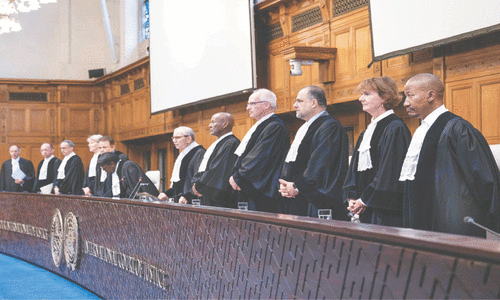
The UN’s top court will on Friday hand down its view on the legal consequences of Israel’s occupation of Palestinian territories since 1967, amid growing international pressure over the offensive in Gaza.
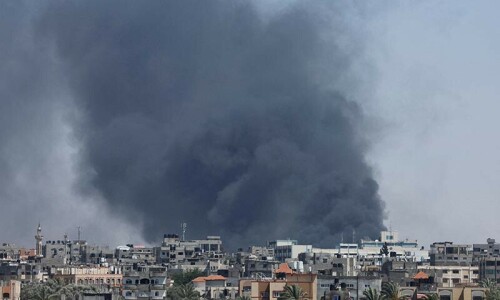
Any opinion delivered by the International Court of Justice (ICJ) would be non-binding, but it comes amid mounting concern over Israel’s onslaught against Hamas sparked by the group’s brutal October 7 attacks.
A separate high-profile case brought before the court by South Africa alleges that Israel has committed genocidal acts during its Gaza offensive.
Judges will read their findings at 1300 GMT at the opulent Peace Palace in The Hague, the home of the ICJ.
The UN’s General Assembly asked the ICJ in late 2022 to give an “advisory opinion” on the “legal consequences arising from the policies and practices of Israel in the Occupied Palestinian Territory, including East Jerusalem”.
The ICJ held a week-long session in February to hear submissions from countries following the request — supported by most countries within the Assembly.
Most speakers too during the hearings called on Israel to end its 57-year occupation. They warned a prolonged occupation posed an “extreme danger” to stability in the Middle East and beyond.
But the United States said Israel should not be legally obliged to withdraw without taking its “very real security needs” into account.
Israel did not take part in the oral hearings.
Instead, it submitted a written contribution in which it described the questions the court had been asked as “prejudicial” and “tendentious”.
‘Ongoing violation’
The General Assembly has asked the ICJ to consider two questions.
Firstly, the court should examine the legal consequences of what the UN called “the ongoing violation by Israel of the right of the Palestinian people to self-determination”.
This relates to the “prolonged occupation, settlement and annexation of the Palestinian territory occupied since 1967” and “measures aimed at altering the demographic composition, character and status of the Holy City of Jerusalem”.
In June 1967, Israel crushed some of its Arab neighbours in a six-day war, seizing the West Bank including east Jerusalem from Jordan, the Golan Heights from Syria, and the Gaza Strip and Sinai Peninsula from Egypt.
Israel then began to settle the 70,000 square kilometres of seized Arab territory.
The UN later declared the occupation of Palestinian territory illegal, and Cairo regained Sinai under its 1979 peace deal with Israel.
The ICJ has also been asked to look into the consequences of what it described as Israel’s “adoption of related discriminatory legislation and measures”.
Secondly, the ICJ should advise on how Israel’s actions “affect the legal status of the occupation” and what are the consequences for the UN and other countries.
The ICJ rules in disputes between states. Normally, its judgements are binding although it has little means to enforce them.
In this case however, the opinion it issues will be non-binding, although most advisory opinions are in fact acted upon.