KARACHI: North Korea’s nuclear technology is much better than Pakistan’s, nuclear scientist Dr Abdul Qadeer Khan said on Monday, but ruled out any assistance from Islamabad to Pyongyang in this regard.
In a telephonic interview to BBC Urdu, Mr Khan insisted that North Korea was self-reliant in the nuclear field because of its highly qualified group of scientists.
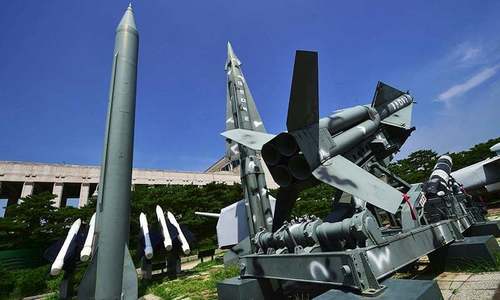
His comments came a day after North Korea said it successfully tested a hydrogen bomb. It was the country’s sixth nuclear test and is considered the most powerful weapon Pyongyang has ever tested.
Mr Khan, said to be the father of Pakistan’s nuclear programme, said he had been to North Korea twice under a missile programme, and found that they had much better quality than Pakistan. “Their scientists are highly capable, and most of them have studied in Russia.”
Recalls he visited North Korea twice under a missile programme
Russia and China would never leave North Korea alone, he said, recalling the two countries’ support for Vietnam during its 20-year war with the United States.
In February 2004, Mr Khan confessed to having supplied nuclear technology and expertise to North Korea, Libya and Iran.
When asked about Pakistan’s role in North Korea’s nuclear programme, Mr Khan rejected the notion out of hand. “It’s out of the question. They have much better overall technology than ours. We have the same old and conventional technology,” he said.
However, he said Pakistan’s relationship with North Korea for the missile programme was common knowledge. “In fact, the Pakistani government itself announced that we were in contact with North Korea.”
On North Korea’s latest adventure, Mr Khan said the hydrogen bomb tested by Pyongyang had the capacity to destroy any city within minutes.
“Hydrogen bombs are much more powerful than atom bombs. For instance, an atom bomb may destroy the area in the radius of 1.5 to two kilometres, but a hydrogen bomb can devastate an entire city,” he said.
Published in Dawn, September 5th, 2017