6
6

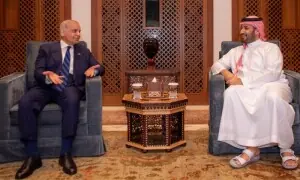
AS the developments coming out of Riyadh on Wednesday illustrated, the Kingdom of Saudi Arabia is experiencing a period of great political change.
While the reshuffle in government posts can be considered merely an internal Saudi matter, in truth the changes have far greater implications, with long-term consequences, for the way Riyadh conducts its foreign policy and domestic affairs. It reflects a mix of internal politics within the House of Saud, as well as the realisation that shifting regional and global realities require the kingdom to adjust its course accordingly.
Also read: Saudi king names new heir to throne in govt shakeup
King Salman — months after taking over following the previous monarch Abdullah’s death in January — has named his nephew Mohammed bin Nayef as crown prince, replacing his half-brother Muqrin.
The king has also named his son Mohammed as second in line to the throne.
Moreover, Prince Saud, son of assassinated monarch Faisal, has been replaced as foreign minister by the current Saudi ambassador to Washington. Prince Saud had occupied the post since 1975, while this will be the first time a non-royal will head the sensitive foreign ministry.
As in any system, the moves can be interpreted as a new ruler’s attempts to consolidate power and place ‘his men’ in all key positions.
Yet beyond mere consolidation of power, King Salman’s moves illustrate the first concrete example of the much talked-about generational shift within the House of Saud.
The king is nearly 80 and by naming his nephew as crown prince, the way has been cleared for the grandsons of Abdul Aziz bin Saud — the kingdom’s founder — to one day occupy the Saudi throne.
Up till now only the sons of Abdul Aziz have ruled the kingdom. Secondly, the move shows that the architects of the Yemeni campaign — the new heir as well as the deputy crown prince — have been made critical players in Saudi politics. The kingdom’s campaign targeting Yemen’s Houthis has displayed an uncharacteristically muscular Saudi foreign policy, perhaps serving as a harbinger of the way Riyadh will conduct its external affairs from now on. These are turbulent times for Saudi Arabia and the entire Middle East, with the region made increasingly unstable by wars and the rise of Islamist militant movements, especially the self-styled Islamic State. Hence navigating these currents for Saudi Arabia will be a considerable challenge, one that the new generation of princes that has just been empowered will have to deal with head-on.
Published in Dawn, April 30th, 2015
On a mobile phone? Get the Dawn Mobile App: Apple Store | Google Play