17
17

KARACHI: While the Sindh Environmental Protection Agency has approved the controversial Clifton traffic improvement project, there is danger of caving in of the tunnel in which lies the magnificent historical Shree Ratneswar Mahadev Temple.
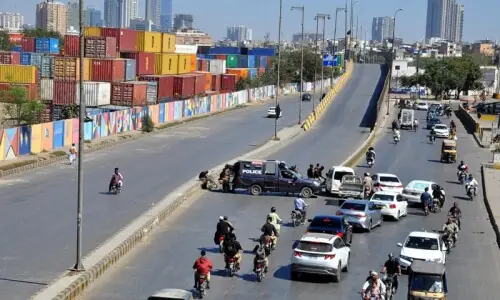
Work on the project, including a flyover and two underpasses, started without taking into account the existence of the underground temple nearby.
The two inconspicuous staircase entrances at the Jehangir Kothari Parade in Clifton downplay the grandeur of the temple. The stairs lead to as many as six levels below. This temple is the most beautiful architectural wonder in this city by the sea. Situated so near the sea, a sweet water spring at its lowest ebb is another of nature’s miracles.
“Just like many Muslims believe that Baba Abdullah Shah Ghazi’s shrine next door holds the sea back from flooding the city, we have our Lord Shiva here. It is our belief that Shiva’s third eye watches over the sea and keeps it in check,” said Ravi Dawani, general secretary of the All Pakistan Hindu Panchayat, while showing the Dawn team around the place.
Also read: Clifton projects controversy sparks debate on ‘intelligent development’
“As you can only see our two entrances from the outside, it was assumed that the temple was probably somewhere inside the Bagh Ibne Qasim,” said Mr Dawani. “But actually it is situated in the opposite direction, under the parking area. And the tunnel in which lie its fifth and sixth basement levels, leads to the Mohatta Palace, according to legend.”
Many spectacular statues of the various Hindu deities in glass showcases have been sculpted by Fakeera, a student of the late Gulgee. There’s Ram and Sita, Kali Mata, Narayan Bhagwan, Saraswati, Ghanesh and Lakshmi with her pot full of gold guineas. On the fifth level below, behind the largest showcase, if one strains one’s eyes and focuses beyond the glass one can see the continuation of the tunnel, said to be leading to the Mohatta Palace.
The fourth level is a courtyard. You pass by a fat cat curled up in a corner of the shiny marble floor. It opens its eyes, lifts its head, yawns and goes back to sleep. On the terrace above there is a cement pigeon house with clean water and feed for the birds. You hear more chirping but it’s not coming from the pigeon house. There are more birds inside and they have made little pockets in the rocks their home.
But many of these rocks in the cave have developed fresh cracks due to the digging and heavy construction work outside. The cracks are also visible from one of the open-air mezzanine floors shaded by a 150-year-old pipal tree.
Asked why the temple management didn’t raise alarm the moment the digging started, Mr Dawani said that just like the diggers didn’t realise there was a temple and a cave under the road, the temple management also didn’t expect them to start digging in its direction. “And it all happened way too quickly before it could be stopped,” he said.
Published in Dawn, Aug 10th, 2014