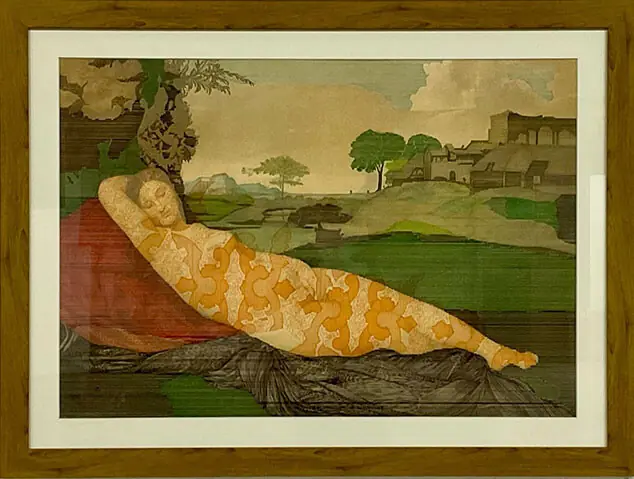
Motherhood has been a recurring subject throughout the history of art. From religious paintings to sculptures, artists have long used it to speak about love, sacrifice and care. In her solo exhibition ‘Where Lines Hold’ at the Sanat Initiative, Ramsha Rubbani revisits this familiar subject through a contemporary visual language shaped by her own experience as a mother.
Although Rubbani comes from a design background, becoming a mother changed the way she began looking at both nature and art. Nature has always remained central to her practice, but motherhood became, for her, its most sacred and powerful expression. Rather than depicting motherhood as an ideal or a social role, the exhibition approaches it as something instinctive, intimate and deeply grounded in nature.
The series was inspired by the artist’s visit to Europe, where she encountered centuries of artworks celebrating maternal relationships. Images of the Madonna and Child and Michelangelo’s Pietà became important points of reference for Rubbani, not only because of their artistic significance but because of how naturally motherhood continues to exist within public and cultural spaces.
Returning home, Rubbani became increasingly aware of the absence of similar imagery and conversations surrounding motherhood in Pakistan. This realisation became the starting point for the exhibition.
A recent exhibition in Karachi drew upon classical religious imagery and personal experiences to offer an intimate meditation on nature, identity and motherhood
In works from the Hold Close to My Heart series, Rubbani digitally manipulates and reconstructs historical imagery into compositions that feel both familiar and contemporary. The figures retain the tenderness of classical iconography, yet they no longer belong to a specific place or time. Their identities remain deliberately anonymous, allowing the emotional relationship between mother and child to become the true focus of each work.
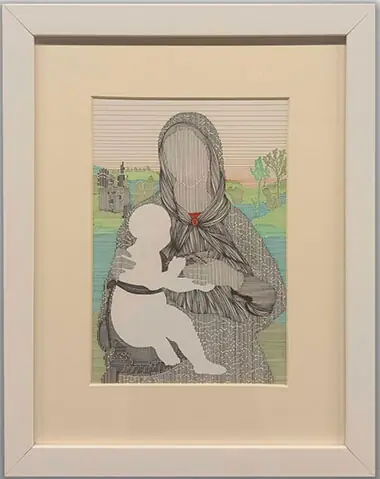
One of the exhibition’s most striking visual elements is the treatment of the faces in the Hold Close to My Heart series. Instead of facial features, Rubbani fills these spaces with countless fine vertical lines. The lines do not erase identity. They can be read as a reflection of the discipline, emotional labour and quiet resilience that motherhood often demands. At the same time, by removing individual identities, Rubbani allows these figures to represent something larger than a single person and become symbols of motherhood itself.
This dialogue between past and present continues in Woven in Love, where biblical and mythological references are reinterpreted through the artist’s own visual language. Rather than borrowing these familiar images as symbols of devotion alone, Rubbani reshapes them into reflections on contemporary motherhood, care and nurture.
The technical execution of the works is equally compelling. In One Dusky Evening and On the Grass, Rubbani combines digital manipulation with intricate hand-drawn line work so seamlessly that, at first glance, the images almost appear to have delicate tracing sheets layered over them. This illusion of transparency encourages viewers to move closer, where the precision and patience behind every mark gradually become visible.
In Under Your Guideline, the painstaking accumulation of fine linear marks demonstrates the artist’s remarkable control of the medium. The dialogue between digital technology and traditional mark-making is handled with sensitivity, with neither medium overpowering the other.
The muted greys, pale greens and soft blues create a quiet atmosphere, while occasional accents of red gently guide the viewer’s attention through the compositions. This restrained colour palette allows the lines to remain the strongest visual element, without overwhelming the delicate emotional tone of the exhibition.
At times, the reliance on familiar religious compositions makes certain works feel closely tied to their historical references. However, Rubbani’s personal experience and thoughtful handling of the imagery prevents them from becoming mere reinterpretations. Instead, they become reflections on care, memory and the universality of maternal love.
In a society where motherhood is often treated as a responsibility rather than something openly celebrated, and where conversations around maternal care largely remain within the private sphere, Rubbani’s exhibition brings these experiences into public view. Whether one enters the exhibition as a mother, a child or simply as a viewer, the works leave enough space for personal memories to surface, making the exhibition feel both intimate and universally relatable.
‘Where Lines Hold’ was on display at the Sanat Initiative in Karachi from June 30-July 9, 2026
The writer is a Karachi-based visual artist currently pursuing an MPhil in Visual Arts at the National College of Arts (NCA), Lahore
Published in Dawn, EOS, July 19th, 2026