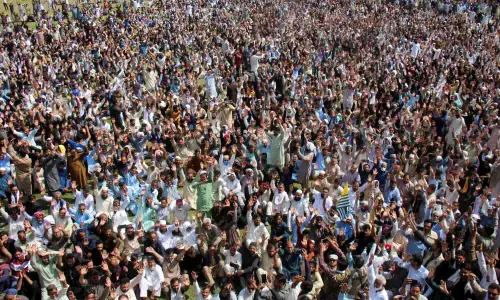
SINCE early June, Azad Kashmir has been on tenterhooks, with routine life severely disturbed, as the regional administration seeks to quell the protests of the now proscribed Joint Awami Action Committee, a coalition of political and civil society groups.
Violent confrontations have claimed some 30 lives of both security personnel and protesters since last month. Rawalakot, the focal point of the protest movement, has been under curfew for about six weeks.
The JAAC’s demands have focused on governance issues and economic concerns, with most being accepted by the authorities. But its call for the abolition of seats in the AJK legislature for refugees from India-held Kashmir has created a deadlock. Violent clashes on Tuesday resulted in at least nine deaths. Yesterday, the JAAC launched its ‘long march’ on Muzaffarabad.
The primary concern of all stakeholders should be the restoration of calm in AJK. Too many valuable lives — of both LEAs and civilians — have been lost, and while violent elements must be prosecuted by the state, the only way out of this imbroglio is through the political process.
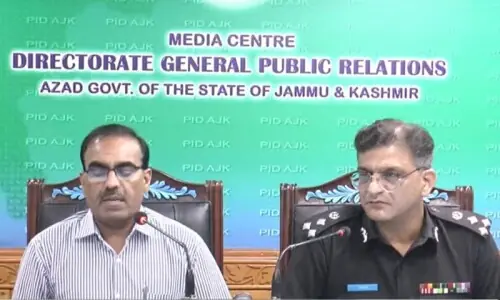
Officials say that some JAAC activists have been armed. However pressing the JAAC considers its demands, armed action against the state cannot be tolerated and those involved in attacks on LEAs must face the law. For the moment though, temperatures must be brought down, and the authorities and the JAAC must show flexibility and engage each other instead of hardening their respective positions.
The authorities have valid concerns about the JAAC’s mode of protest and some of its demands; however, they should talk to the group instead of trying to crush it — a reaction that has often backfired in the past. On its part, the JAAC must communicate its demands in a peaceful manner, and recognise that constitutional issues, such as the question of refugee seats, can only be settled in the legislature and not on the streets.
It is incumbent on political actors within AJK and Pakistan to step up efforts for a negotiated solution to this crisis. In AJK yesterday, PPP chief Bilawal Bhutto-Zardari proposed a truth and reconciliation commission for settling the matter, while the Jamaat-i-Islami has formed a ‘peace jirga’ in an attempt to mediate between the AJK administration and the JAAC.
The PTI has similarly called for a multiparty moot to develop a ‘national consensus’, especially with regard to the regional polls scheduled for later this month. It goes without saying that fair elections require a peaceful atmosphere and a level playing field for all contenders.
Rather than using only administrative and security tools to deal with the situation, the government must keep political channels open with the JAAC and carefully listen to their demands so that normal life can resume in AJK as soon as possible.
Published in Dawn, July 16th, 2026