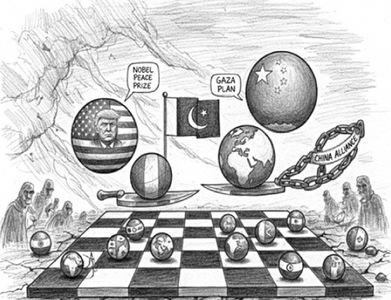

The year 2025 was exceptional for Pakistan’s geoeconomics and geopolitics. The most dramatic moment was the May 7–10 conflict with India, a confrontation whose political and economic repercussions continue to shape Pakistan’s trajectory. In its aftermath, Pakistan emerged more confident, actively pursuing defence and strategic economic partnerships to reinforce its long-term security.
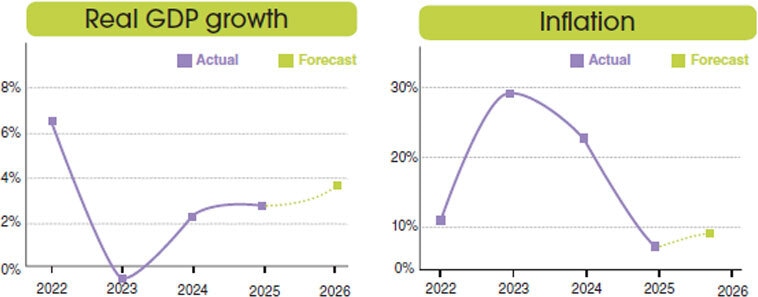
The economy also saw a significant improvement in global perception, reflected in successive upgrades by major international rating agencies, including Fitch, S&P, and Moody’s. These upgrades noted strengthened macroeconomic stability, an improved external position, and steadier foreign exchange reserves. The primary balance, showing that the government’s revenues exceed its non-interest expenditures, rose to a historic high of 2.4 per cent of GDP. Equally notable was the sharp decline in headline inflation, which fell below 5pc, its lowest level in seven years.
The launch of a new, outward-looking trade policy, signalling a decisive break from decades of protectionism, is one of the most consequential reforms. The five-year policy aims to make Pakistan one of the most open economies in the region by eliminating para-tariffs, streamlining exemptions, simplifying the tax structure, capping the maximum rate at 15pc, and reducing tariffs on nearly half of all tariff lines, with almost half going to zero. If fully implemented, it would rank Pakistan among the world’s most ambitious tariff reformers over the past two decades, according to the World Bank, sending a strong signal of commitment to competitiveness, global integration, and export-led growth.
Another highlight of the year was the financial closure of the Reko Diq copper-and-gold project in Balochistan, achieved nearly 15 years after completion of the feasibility study — including the six years lost to litigation. The $7 billion project is backed by a strong consortium of sponsors, including the International Finance Corporation, the Asian Development Bank, and financial institutions from the US, Canada, Japan, and Saudi Arabia.
Though much has yet to be achieved on the social front, the year offered a boost not only to homegrown economics but also to Pakistan’s international stature
Construction activity is expected to gather pace in early 2026 as well, with commercial production projected to begin in 2028, potentially generating around $2.5bn annually in export earnings.
After a hiatus of nearly two decades, Pakistan has revived its long-stalled privatisation agenda, starting with the sale of the debt-ridden Pakistan International Airlines (PIA) to a private consortium.
For years, PIA stood as a symbol of chronic mismanagement, political interference, and persistent fiscal hemorrhaging, with accumulated losses estimated at more than $2.5bn, imposing a heavy and recurrent burden on the national exchequer. The transaction represents a notable policy inflection, signalling the government’s readiness to take politically difficult decisions to curb losses, restore efficiency, and progressively reduce the state’s footprint in commercial activity.
Moreover, Pakistan’s stock market continued a stunning surge in 2025, with the KSE-100 Index beating all previous records to an all-time high of over 170,000 points and earning a place among the world’s top-performing markets. Bloomberg ranked Pakistan “among the best-performing markets globally,” noting that its returns outpaced nearly every major index. Barron’s went a step further, hailing the turnaround as a rare “mini miracle,” fuelled by reforms, macroeconomic stabilisation, and a decisive return of investor confidence.
Yet, the year was not without setbacks. Agricultural growth suffered a sharp downturn, falling from 6.4pc in FY24 to just 1.5pc in FY25. Major crops were severely affected, including cotton declining by over 30pc, maize by 15pc, and wheat by 9pc. This contraction slowed the anticipated reduction in poverty rates and underscored the continued vulnerability of the agricultural sector.
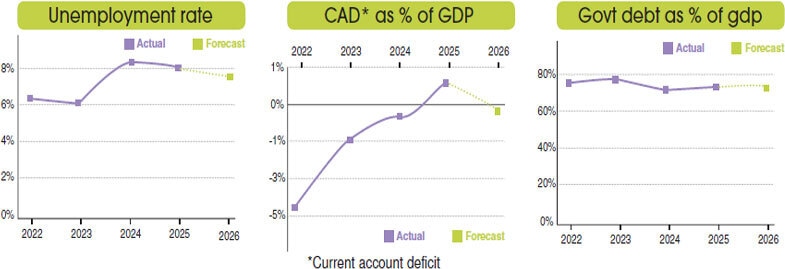
Another low point was Pakistan’s unemployment rate, which rose to 7.1pc in FY25, the highest level in 21 years, underscoring the economy’s failure to generate productive jobs. Compared to 64pc males, only 18pc females are employed as per the Labor Force Survey. Six in 10 Master’s-degree-holder women are not currently employed. The combination of high unemployment and widespread unpaid work highlights the urgency of growth strategies that can create decent, paid jobs, especially for women and youth, and convert hidden labour into productive economic participation.
Perhaps the lowest point for Pakistan is its fall to the very bottom of the World Economic Forum’s Gender Gap Index 2025, ranking 148 out of 148 countries. This stark outcome signals a clear deterioration in women’s economic participation, widening wage inequality, and an alarmingly weak presence of women in decision-making.
Pakistan’s poor performance is the result of structural constraints such as persistent barriers to women’s entry into the economy and governance, weak implementation of gender-inclusive policies, and entrenched sociocultural norms.
The writer is a member of the Steering Committee for the implementation of the National Tariff Policy 2025-30. He has previously served as Pakistan’s ambassador to the WTO and FAO’s representative to the United Nations
Published in Dawn, The Business and Finance Weekly, December 29th, 2025