0
0
NCSW head says empowering women’s choices a constitutional obligation
Expert stresses reproductive right fundamental for gender equality
Businesswoman says need to educate men as well
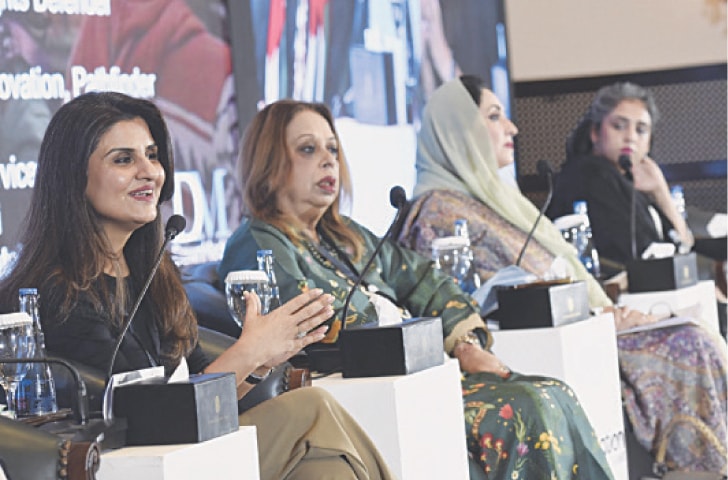
ISLAMABAD: An all-women panel at DawnMedia’s Population Summit said women’s right to decision-making should be central to all policies for inclusion “in the true sense”, as this will enable them to make informed and autonomous decisions regarding their bodies.
In a session titled ‘Empowering Women and Their Choices’, the speakers stressed the importance of economic agency, the importance of informed choice decisions about reproductive health, and continuity in the government policies regarding women.
The panel, moderated by Tahera Hasan, Imkaan Welfare CEO, featured activist Tahira Abdullah, Population Services International’s country director Ayesha Leghari, QZ Catalyst head Dr Yasmeen Sabih Qazi, Pathfinder’s Strategic Engagement and Innovation Department Vice President Madiha Latif, National Commission on the Status of Women (NCSW) head Umme Laila Azhar, and former Women Chamber of Commerce and Industry president Shamamatul Amber Arbab.
Tahira Abdullah, a rights defender, noted that the subject of population balance had become an “existential challenge”. She also called for an end to the “feminisation of poverty”.
She cited World Bank and past figures, according to which 45pc of the country’s population lived below the poverty line, and women and transgender people made up 75pc of that. The rights defender also demanded an end to unpaid labour by women.
NCSW head says empowering women’s choices a constitutional obligation Expert stresses reproductive
Ms Leghari stressed the importance of ‘economic agency’ for women, saying that once they started becoming economic contributors in their households, women’s decision-making improved substantially, not just in their households.
She said women also became more autonomous in making decisions regarding their bodies. “They started choosing contraceptive methods of their choice, they started investing the money they were earning into their daughters, and we saw a dynamic change,” she said.
Ms Leghari said there was a need to keep cultural sensitivities in mind to avoid any potential backlash, adding that there was a need to push boundaries gradually.
The QZ Catalyst CEO underscored the need for inclusion in a “true sense” in response to a question regarding the delivery of interventions to undocumented communities.
“We should make a position that a woman’s autonomy and a woman’s right to make a decision should be central to all the policies…,” she added.
Dr Yasmeen Qazi also noted that there was a need to ensure ‘continuity’ in providing healthcare to women.
“From adolescence to pregnancy to post-partum, at every point of her life, she would need that kind of information which we fail to provide in a classical facility setting,” she said, while calling out the government for its selective approaches and failure to deploy innovative policies.
Meanwhile, Ms Arbab said there was a need to educate men as unilateral measures would lead to “friction”.
She said the friction resulted because “we are not educating their counterparts, we are not educating the men in their families.”
Madiha Latif, on the other hand, stressed the need to make women, particularly young women, aware of their reproductive rights.
“Reproductive right is also fundamental for gender equality,” she said.
“Censorship is not the way to go anymore,” Ms Latif asserted, noting the need to create awareness among women about their control and choices in sexual activities.
She said women were often “infantilised” when they go into hospital emergency rooms or healthcare providers.
“Providers are the ones discouraging a lot of these fertility management techniques, where they are telling her ‘you are too young to make that decision’ or that ‘you have only one child’,” she said.
“Who are those providers to make those decisions for us,” she asked, saying that “we talk about nutrition and breastfeeding, but we don’t give space to women to breastfeed safely at work”.
The NCSW head termed the act of enabling women to make their own choices “a constitutional obligation”.
“Pakistan stands at a socio-economic crossroads, and empowering women’s choices is not just a soft issue; it’s a constitutional obligation,” she said.
“When girls and women can choose their education, work, mobility, marriage, and health decisions, entire communities become more resilient, productive, and peaceful, and this is not about individual empowerment; it is nation building,” she added.
Published in Dawn, December 3rd, 2025