In 1928 when the riots against the Simon Commission Report started, outside Anarkali Bazaar at Nila Gumbad, the British rulers lay waist-high barbed wires. People going to Anarkali Bazaar were asked to crawl under them. The same was true around the famous and ancient Gol Bagh.
These actions were yet another way of insulting the people of Lahore. Every time in my youth when I walked past this area, my late father would remind us of that happening. It was a way of reminding us of the positives of our ‘freedom’ … not that given conditions today this could not happen again.
But then Nila Gumbad is currently in the middle of a massive change, where the traders – just like the old walled city ones – were resisting only for them to be promised new shops in a proposed ‘parking plaza’.
The ‘parking plaza’ plans for Lahore are now a worrisome proposition. For the one at Nila Gumbad if its height overshadows the Nila Gumbad itself, let alone the KEMC, the Ewing Hall and the beautiful surroundings for which Nila Gumbad is famous, that will invite protests, and rightly so.
But then a leading political family, so a property source in London tells me, own a few buildings, including a parking plaza. All our readers need do is go to the internet.
The economics of a parking plaza is mouth-watering. In a 500-car position plaza normally over thrice the numbers are parked over 24 hours. At the rate of Rs200 per car it means over Rs100 million rupees a year. Not bad at all. No wonder.
But before this happens it would be prudent for Punjab’s ‘leading lady’ to reconsider the design and move downwards avoiding a high plaza. Lahore has hundreds of thousands of motorcars and the world largest motorcycle numbers, hence there is a need for hundreds of parking plazas. But then the law says such commercial enterprises should not be in public parks and places. But back to Nila Gumbad.
Known for its shiny blue dome that was once visible all over the old city, it serves as the burial mausoleum of the Sufi saint Sheikh Abdul Razzak Maki. He came from Mecca and settled in Lahore during the reign of Mughal Emperor Humayun (1508-1556 AD). He was affiliated with the famous saint Miran Muhammed Shah Mauj Darya Bukhari.
The saint soon realised that his disciple possessed extraordinary skills and Quranic knowledge. He named him Sheikh Abdul Razzaq Makki. The ‘Sufi’ soon gathered a large number of admirers and followers, and his deep knowledge of the Quran spread all over the city. After a while, he was accepted as one of the leading ‘saints’ of his time. His ideas were frequently sought by the Mughal Court.
Sheikh Abdul Razzaq Makki died in Hijri 1084 (1674 AD) and was buried in Lahore. The Mughal Court built a beautiful mausoleum over his grave. Next to the tomb, they built an elegant mosque known today as the Neela Gumbad Mosque. It was in its days one of the most beautiful in Lahore.
Once the Mughals lost power and the Afghans took over control, they set up a cannon-manufacturing factory here. The Zamzama Cannon also known as Kim’s Gun and ‘Bhangian di Top’, is an 18th-century ‘large-bore’ cannon that was built there. It was cast by the well-known metalsmith Shah Nazir of Lahore in about 1757, during the Durrani period. Currently it is on display in front of the Lahore Museum in Lahore. It is the world’s largest pre-modern cannon.
When the Sikhs came to power, they plundered the Nila Gumbad mausoleum and the mosque and took away to Amritsar its marble tiles and carvings. Given the Durrani experience Maharaja Ranjit Singh ordered the mausoleum to be converted into an ammunition depot and had a weapons manufacturing facility built on one side of the mosque.
He built a cannon production facility on the west side of the building, next to the graves. Thus a lot of tombs of some of Lahore’s venerated scholars and saints were destroyed in this process. With time Ranjit Singh changed his stance and started respecting them. Thus the cannon factory was taken to Mughalpura.
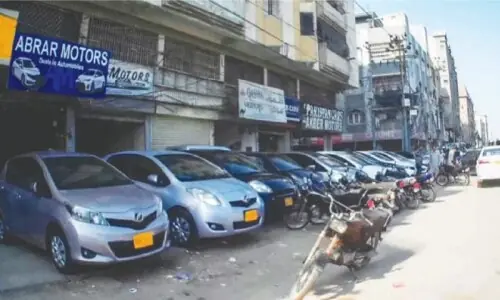
Just as like after 1947 the walled city of Lahore was plundered by traders moving in from Indian Punjab and beyond, in the same manner the bicycle shopkeepers set up shops, damaging the mosque and mausoleum in the process.
With time the blue top was painted in emulsion blue and lost its shine. The illegal structures blocked the view of the historic structures, and some even damaged it. There was a real fear that the structure of the mausoleum and the mosque would collapse.
At three places shopkeepers have badly damaged the brickwork. The damage means that if a little more brickwork is removed the entire structure will collapse. As reports of these developments reached the office of the Punjab bureaucracy, they decided to do something about this damage.
As was expected the shopkeepers started a protest and decided to talk to her. She listened and told them that she would build them new shops in a parking plaza, which ensured that the traffic at crossing remained in ‘free flow’.
As can be seen in newspaper photographs and television news reports, work has started, and the Nila Gumbad bicycle market is no more. In the structure coming up all these shop ‘owners’ will get brand new shops. The questions that arise need understanding.
As one wrote about the Nila Gumbad situation the news splashed in that the ‘leading lady’s team had started cutting down the ancient trees of Gol Bagh. It was in this garden that when Gen. Ayub filled it with water and put live electricity in it to prevent ZA Bhutto holding a meeting, it was the student Nawaz Sharif who lifted his favourite leader on his shoulders and ran towards the GC campus.
It was in this garden that Maharajah Ranjit Singh refused to park his invading army in 1799, moving to the tomb next to Tollinton Market on The Mall. It was in this garden that ancient rulers like Aibak stopped to consider their invasion plans. But now the invasion to eliminate it is there.
My suggestion to the ‘leading lady’ is that she ask her legal ‘minds’ to study the ‘Open Spaces Act 1906’. There have been Supreme Courts’ rulings on this matter in India and Pakistan. In Pakistan the laws of Punjab specifically prohibit “the use of public parks for permanent construction”. The Lordships, whoever is approached, should consider the Parks and Horticulture Authority Act 2012.
Once the parking plazas come up, they will block the old magnificent buildings and educational institutions that surround the gardens. But then there is the question of whether the middle garden will remain or not. When asked my source remained silent. About Nila Gumbad we must be assured that the mausoleum and the mosque are returned to their original Mughal beauty. Why destroy Lahore’s greenery?
Once the Nila Gumbad mausoleum and mosque are finished to the highest standards, as well as the outside area beautifully restored, it will surely be a massive contribution to the history of Lahore. Maybe, just maybe, people will try to learn more about Sheikh Abdul Razzak Makki, a scholar in his own right. About Gol Bagh … that is another story. It’s a paying proposition !!!
Published in Dawn, November 30th, 2025