Spotlight on ‘female gaze in cinema’ at Doha film fest
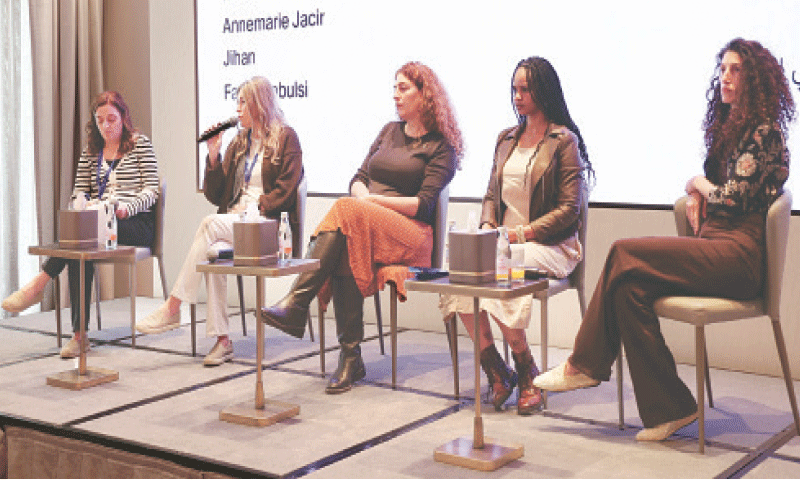

DOHA: How does gender inform filmmaking and what do women directors bring to the table when venturing into films, especially dealing with the gender stereotypes and its reflection in their work. These questions were a part of an important panel discussion, ‘Reframing Cinema: Diversity in the Female Gaze’, during the Doha Film Festival.
The panellists included Palestinian filmmaker Annemarie Jacir, Libyan-Syrian director Jihan K, British-Palestinian filmmaker Farah Nabulsi and Rawia AlHag from Sudan.
For Ms Jacir, whose film Palestine 36 was screened at the festival, the question of identity, including that of gender, did not come first.
“I don’t start from the question of stereotypes — of women, Arabs and all the people. I can’t start my work from the response to the stereotype. What I try to do is to tell the story that is true for me.”
She said Palestine 36 dealt with this bigger historical epic moment and the female characters in the film were of the women that she knew.
The characters belonged to two different classes of women, represented by a journalist writing under a male name to be taken seriously and also to protect herself from a colonial government and a village woman with a history of resistance.
“I was interested in catching their reality and truth. I was also interested in noticing that as a Palestinian woman, things changed for the worse. In the Second Intifada (2000-2005), women were very much on the street and involved. Now in Palestine, just as in a lot of other countries, women have been pushed out of the scene.”
Jacir explained that she was being true to the history rather than battling a stereotype though she knew that each of women directors in the panel was battling a stereotype.
Farah Nabulsi, whose 2020 short film, The Present, was nominated for an Academy Award, said her latest projects, The Present and The Teacher, had male protagonists and people sometimes wondered why she did not have female protagonists but it’s necessary.
“My role as a woman as my lived experiences as a mother, sister and daughter had influenced my storytelling approach and that’s why I have a parental presence in the film despite having a man as the protagonist. Being a mother has informed me because I know it has infused itself into the story I wanted to tell.”
Farah referred to an intangible spirit in my films even if they dealt with male-dominated stories. “There is an intangible essence women bring to their stories regardless of the type of stories. Even though stereotypes exist but cinema has a very powerful way of overcoming that,” she said.
Rawia AlHag, the director of Khartoum, said she started working on her film to portray the city of Khartoum that she and all people of her country loved but her responsibility had become bigger because of the war in Sudan. “This film is a means for us to remind the world and to convey the voices of Sudanese women, children and men and people as a whole—in a world where everything is very political.”
Najiba Noori was a journalist in Afghanistan when the Taliban took over in 2021. She had to flee Kabul at the time of takeover and landed in France. Before the Taliban took over she was making a documentary on her own mother, Hawa.
As the Taliban forces took power, the political turmoil provided another nuance to her film that she made a part of it. However, most of the film, Writing Hawa, deals with the conditions before the start of the Taliban rule. Weaved around the character of the mother, the film tells the stories of three generations of Afghan women.
The film is a daughter’s homage to her mother who was a victim of child marriage and she was married off with a man who was thirty years older than her. As the film shows, despite her lack of education, the character of mother reveals progressive ideas regarding women education and rights. In her old age, Hawa starts learning writing with her grandchildren, dyes her hair black and ventures into entrepreneurship.
Published in Dawn, November 28th, 2025