FESTIVAL: A CITY’S READING HABIT ON DISPLAY

Literary festivals often try to impress audiences with grand declarations about culture and community. The 10th Adab Festival in Karachi did not rely on any of that. It worked on another rhythm altogether.
It was shaped by movement, crowds, close distances, overlapping sessions, and the feeling of walking through a city’s reading habit put on display. It felt less like a polished showcase and more like a lived-in meeting ground, where people came for books but stayed for everything orbiting around them.
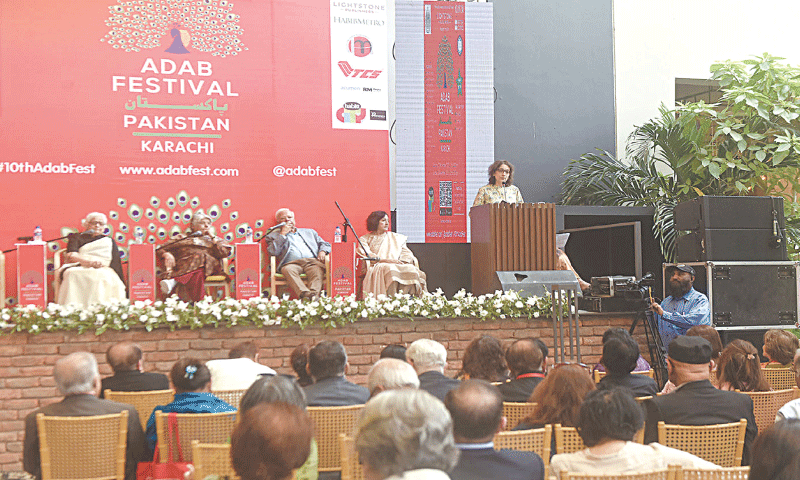
The festival opened at Habitt City with plenty of ceremony. Poet Zehra Nigah presided over the inauguration, and the students of Roots Millennium School began the day with the national anthem. The festival’s founding director, Ameena Saiyid, and Habitt City’s CEO, Munis Abdullah, welcomed the visitors, setting the tone for the kind of space the Adab Fest tries to create every year, one that pulls in readers, writers and the generally curious from all corners of the city.
The announcement of the Infaq Foundation Adab Festival Literary Awards followed shortly after, highlighting works across Sindhi, Urdu and English. The line-up of awardees and speakers reminded everyone how large the country’s literary landscape actually is, even when we tend to view it through a narrow lens.
Ten festivals in, the Adab Festival has settled into its own personality. It is dense, loud, packed, informal and full of people who arrive with strong reading habits or at least a strong curiosity
A major part of the emotional core of the day came during the ‘Tum Yaad Aaye: In Memoriam’ segment. A long list of names of artists, writers and cultural workers filled the hall with a kind of quiet acknowledgement of their loss. Shayma Saiyid sang a piece once sung by Nayyara Noor. It created a pause in a festival that otherwise kept the crowd on a steady shuffle from sections titled ‘City Talks’ and ‘Arena’. For a moment, everyone in the hall stayed still.
The rest of the first day moved fast. Sessions ran at the same time in different corners of the venue, which meant most visitors spent the day choosing between topics that deserved attention. Urdu literature, political thought, history, education, the environment and art kept showing up in different combinations. One could sense how the city’s own restlessness shaped the event. Karachi likes to multitask and the festival mirrored that habit.
The children’s area stood out this year. Parents kept drifting in with small backpacks and snack boxes while the kids were pulled into puppet shows, crafts, talent segments, writing workshops and a steady bustle of voices. Storytelling by Yasmin Motasim had its own following and Taha Kehar’s writing workshop for teenagers looked packed from the moment it opened. The organisers clearly wanted the younger visitors to feel included in the life of the festival, and the result was a small corner that felt like its own world.
Among the more talked-about conversations was the ‘Karachi Biennale: Connecting Art, the City and its People’ featuring curator Noor Ahmed, artist Amin Gulgee and the founding trustee of the Karachi Biennale Trust Bushra Hussain, moderated by journalist Syed Hasnain Nawab. The panellists discussed how creative work interacts with urban spaces. Short films made by schoolchildren were also screened, which delved into various sectors and regions of Karachi, for instance Stories of Saddar, which explored the fish market and the workers who grew up inside that world. Another short film looked at neighbourhood changes and the tension created by imported goods. The clips added a rawness that adults often filter out. These small documentary glimpses also made the session feel grounded rather than abstract.
Another session, ‘The Cultural Relationship of Sindh with the River and the Sea’, was moderated by writer Noor ul Huda Shah and the panellists were musician Saif Samejo, development practitioner Naseer Memon and novelist and environmental activist Zubeda Birwani. It explored how landscape shapes identity. Shah used the feminine gender for the Sindhu (Indus River). It changed the tone of the discussion and made the idea of land feel personal instead of distant. Naseer Memon spoke about water scarcity, the advent of corporate agriculture to provide livelihood and the practical limits of irrigation and large-scale food security in a region where months can pass without water eight months in a year. The session moved with a calm rhythm, even as the subject carried weight.
The first day closed with book conversations that appealed to a mixed audience. Amber Zaffar Khan’s My Friend Maya was introduced with a relaxed discussion about friendship, memory and the emotional terrain of growing up. Shabbar Zaidi’s 32 Onkar Road brought a very different energy. He spoke about childhood routines, cinema trips, politics and how economic and social shifts ripple into family life. His mention of “voluntary socialism” and blending of reason with emotion stood out as a window into the book’s internal logic. At the same time, a session on the late Syed Muhammad Taqi’s The Future of Civilisation kept the Arena section busy as the panellists explored resistance, dissent and the politics of refusing to be silenced.
The evening session on Heer by Waris Shah gave the audience a different mood. Sarwat Mohiuddin’s take on the text flowed into a performance by Usama Israr Ahmed, adding music as a kind of commentary rather than decoration. Afterwards, a multilingual mushairah brought speakers from several languages on to one stage. The crowd seemed to grow with every recitation and the atmosphere turned into something close to a street gathering, but indoors.
The second day, I entered slightly later in the day, owing to it being a Sunday. The book launch of Athar Tahir’s Where Cicadas Sing had already begun. The author was joined by novelist and publisher Safinah Danish Elahi and communications and design professor Christie Lauder of Habib University, with communications strategist Shahzad Abdullah moderating. The conversation steered toward the voice in the book and how childhood identity can carry a strange clarity. Lauder pointed out that a child narrator can say things that an adult narrator might not have the privilege of getting away with. That observation stayed in the air long after the conversation ended.
Right after that, writers Shandana Minhas and Taha Kehar held a session on Minhas’ latest novel Ferdowsnama. Her shift toward a more historically rooted narrative required serious research and she spoke openly about the process. The audience responded well to her honesty about the labour involved.
The mood changed again when Shehzad Ghias’ Pakistan Lost: Ideas on the Idea of Pakistan was discussed in a panel led by journalist Amber Rahim Shamsi. Columnist Nadeem Farooq Paracha, journalist Zahid Hussain and writer and policeman Omar Shahid Hamid approached the subject from different angles, circling around the many ideas that have shaped the national story over decades.
The challenge of the festival became clearer by the second day. Too many sessions (that I wanted to attend) were happening at the same time. One had to choose between equally meaningful conversations. The venue itself had charm but the tight walkways and the constant back and forth made movement tough. People kept stopping to talk to writers, which added to the crowding, although it provided the emotional engagement and warmth required in such festivals. It was the kind of environment where you bumped into an author while trying to find your next session.
Ten festivals in, the Adab Festival has settled into its own personality. It is dense, loud, packed, informal and full of people who arrive with strong reading habits or at least a strong curiosity. The festival continues to provide Karachi a cultural marker every year, and sometimes even twice a year! It shows how many voices live in the city and how many more keep showing up. The result is a kind of organised excess. And maybe that is the most Karachi thing about it.
The writer is the head of content at a communications agency
Published in Dawn, Books & Authors, November 30th, 2025