0
0
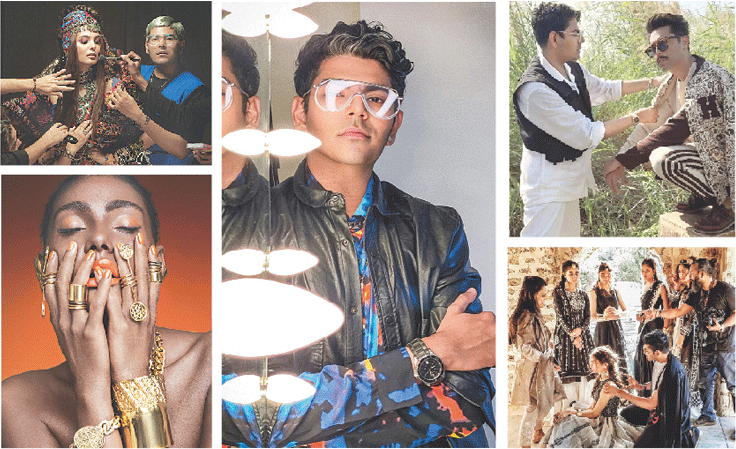
I ask Tabesh Khoja where he would want to see himself five years from now? “Hopefully, still somewhere on the top,” he replies promptly.
Is it presumptuous of him to assume that he is currently slotted in the upper echelons of Pakistan’s fashion and style spheres? I don’t think so. Over the past 14 years, Tabesh has worked relentlessly to gain the respect and clout he commands today as a stylist.
The ego games, tantrums and the notorious Karachi-Lahore divide running rampant in the local fashion industry don’t seem to have made a difference to him while he has gone about building his repertoire, ricocheting from fashion shoots to celebrity stylings to awards ceremonies. Somewhere in between, he also offers online styling consultations, and hand-picks models and grooms them, until many of them haul in awards and work in major campaigns.
There was a time when there was no concept of stylists in Pakistani fashion. Designers, models, photographers and hair and make-up artists would put together a shoot, but there would be no professional hired to make sure that the dupatta fell just so, who could advise that the hair needed to be a beautiful mess, that a garment of a particular colour could be accentuated with the aid of a certain lip-shade, and who could point out that a model needed to have a certain kind of physique to model wedding-wear, a certain look to carry off Western-wear or, a certain height for the catwalk.
This was fine back when fashion shoots were few and far between but, as the industry mushroomed into a money-minting behemoth, the realisation soon set in that professionals were needed to curate appealing, high-end fashion images.
Tabesh Khoja was one of the very first stylists to ride this new wave of fashion. Working under the umbrella of Nabila’s network of salons, he was always there at every event worth its mettle, working consistently backstage, only letting loose later at the after-party, putting it all out there on Instagram and quickly becoming a coveted name on his own.
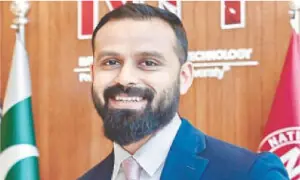
When he started out in the fashion industry, there was no concept of stylists as professionals and Tabesh Khoja admits he was often just ‘a fly on the wall.’ Now celebrated as one of Pakistan’s premier stylists, his journey is testament to how perseverance and hard work can help a career skyrocket
However, somewhere towards the beginning of my interview with him, he confesses, “For a long time, I was just a fly on the wall.”
Not just any ‘fly’
“I was always attracted to fashion and to the idea of creating an image that showed the best version of a person,” elaborates Tabesh. “Back when I had completed my Matric studies, I remember wanting to buy a pair of jeans by local high-street brand Stoneage.
“My mother told me that, if I wanted to buy the jeans, I would have to earn my own money to get them. This led me to work with my uncle as a paralegal in his firm for some years.”
He continues: “I was a hard worker and my uncle wanted me to inherit his firm. My father had passed away when I was three, so my uncles were like my father figures. The family wasn’t too pleased when I opted to eventually enroll at the Asian Institute of Fashion Design [AIFD], although my mother supported me throughout. Back then, I wanted to become a fashion designer.”
But fate had other plans in store for Tabesh. Designer Asim Jofa — in the initial phase of his career back then — had been a client at Tabesh’s uncle’s firm and become acquainted with Tabesh there. Asim now invited Tabesh to work at his office as an intern and see how things worked in the fashion industry.

“I would go to Asim’s office once my classes ended around noon,” recalls Tabesh. “I didn’t know much, so I would help out however I could. Asim’s first collection had been in collaboration with designer HSY and now he was launching his second line, a solo collection. Frieha Altaf was managing his PR and planning out his exhibit and she would sometimes come to the office. I used to wear kilts and this caught her interest. She asked me how I could wear them while going around Karachi and I replied that I just did!
“At Asim’s exhibit, she told me that you should come work with me and to send my CV to her office. Frieha was perpetually busy back then. She would constantly be helming events, from fashion weeks to exhibits to awards shows to collection launches. I thought that perhaps she wasn’t serious and went back to my studies.
“After some time, though, I got a call from Frieha’s office. A major event was taking place and she wanted me to help out. I went with two of my friends and we started working there as interns.”
Over time, Tabesh became an important cog in Altaf’s PR machinery. “I would go with her before a fashion week when she would be meeting designers and editing collections,” he says. “I would send out emails, travel with her to Lahore and Islamabad, be with her when she cast models for a show. These were exciting times.
“Iraj, Vinnie and Aaminah Haq were at the prime of their modelling careers but were slowly beginning
to exit, ushering in Fouzia Aman and Sadaf Kanwal. I loved just being there, looming in the background, making sure that everything got done.”
He continues: “Then, I was once in Lahore, backstage at the L’Oreal Paris Bridal Week and Nabila was doing the hair and make-up for that day. I was just standing there and she asked me, can I touch your hair? I had long hair at the time and she touched it and told me that it was very interesting. She asked me if I worked for Frieha and I said yes.
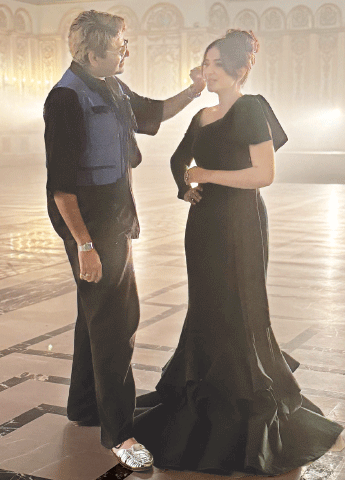
“Some time later, Nabila visited AIFD. She was planning a hair show and was searching for a venue. For some reason, the institute’s dean thought that I would know her and he called me out from class and asked me to show her the campus. I did my best, giving her suggestions on how lights and props could be used at different locations on campus, my production experience with Frieha coming in handy. She asked for my number and left.
“Then, I got a call from designer Zaheer Abbas who was part of the AIFD faculty. He asked me if I was exclusively working with Frieha and I said no, I was a freelancer. Immediately afterwards, Nabila called me. She told me that she was planning to stage her show at the Indus Valley School of Art and Architecture and if I was available for a meeting. I met her that day in the evening. I had asked her to check with Frieha if it was alright for me to work on this show with her and Nabila had done so by then and gotten approval.
“This was back in April 2012. I started working with Nabila on the show. She would pick me from my university around noon every day, which was when my classes ended, and I would be like a personal assistant to her while the show was being planned out. In my free time, I would complete my assignments.
“Nabila and I had a lot of conversations during this time. She had become my mentor, my teacher. She asked me whether I wanted to be a fashion designer or I wanted to be someone who could tell the designer what to make. The question interested me. By then, I was losing interest in designing and was gravitating towards creating beautiful images, selecting models, getting people dressed.”
As the show loomed closer, some of the models’ tutu skirts weren’t ready. Nabila turned to Tabesh with an offer. “She told me that if I could get the skirts ready within time, she would give me the opportunity to work for her. I was on a mission! I got the tailors at AIFD to come in on Sunday, paid them extra money and, several hours before the show began, the skirts were backstage.” He laughs.
“Some days after the show, Nabila called me to her office and gifted me an Apple ProMax laptop. She told me that it would help me with my assignments and I wouldn’t have to make lists and Excel sheets on my phone anymore. She also told me that if I was serious about working for her, she would create a position for me at her salon. Of course I was serious!”
Paving his path
At Nabila’s, Tabesh slowly began to make connections, getting to know the staff, helping out however he could. “I would sit with the photo editor while he worked on a fashion shoot and Nabila would teach me how moderating the colour intensity of an image could make it stand out more or how if the hair looked a certain way, it appeared more beautiful. I developed a vision for beauty through her.”
Tabesh shares: “I would often go with the make-up team to shoots. Back then, Nabila would often be hired to carry out shoots for brands. I would accompany her there with the team and help out, getting models dressed, packing, unpacking. My education in fashion came to use here. I knew drapery and understood fabric, so I would instinctively know where to place the dupatta on an outfit. I didn’t even know that a stylist was something, but this is how I started styling.”
He recalls: “The first shoot that I styled on my own was with model Ayyan for Kiran Fine Jewellery, photographed by Umair Bin Nisar. I remember Nabila included that image in the portfolio that she submitted for consideration at the Lux Style Awards that year. I considered it a great honour.
“Time flew. There were times when I was offered other jobs. The second fashion shoot that I helped with featured Reema Khan, photographed by Rizwan-ul-Haq. Rizwan liked my work so much that he offered me a job right then. And two weeks after I joined, Frieha called me and asked me if I would like to host the Miss Veet Pakistan show that she was planning at the time. It was all very tempting but, somehow, I innately knew that I had to stay grounded and focused in order to build my career.”
He continues, “There came a point when Nabila suggested that I needed to make styling part of my professional identity. I got paid 20,000 rupees for the first shoot that I styled. It was a lawn shoot and, since then, I have never looked back.”
Was Tabesh given credit for the shoot or was the work simply attributed to the overall Nabila entourage? “No, I was always given credit for my work. People knew me, knew my work and the credits, right from the start, stated, ‘Tabesh Khoja at Nabila’s’.”
Did it ever occur to him that he should break away from the Nabila framework altogether and launch out on his own? “No,” he says. “Nabila gave me support and space for growth. She is my teacher, my second home, my fairy godmother. I am very loyal by nature and I have tried to never let her down.
“There is no conflict of interest between my own work and Nabila’s domain. Sometimes people hire me as a stylist and tell me that you can choose whichever hair and make-up team you like. I always choose my own team — the team at Nabila’s — because I have worked with them, trained them and know the results that they can deliver.”
Further on in his career, Tabesh became a major part of Zinc, Nabila’s modelling agency which had gone dormant for a while before it was relaunched in 2021. Tabesh shrugs. “I gained a lot of experience and exposure working first with Frieha and, then, with Nabila. Maybe I do have an eye for knowing which models have it in them to become successes.”
Power plays
There have been times when Tabesh has come across a girl at a restaurant — Sarah Zulfiqar, for instance — and asked her if she wanted to pursue modelling. Or a girl has offered him a soft drink can — model Mushk Kaleem — and he has foreseen that her long legs, height, bone structure and dusky complexion could steamroll her to supermodel-dom.
There are some who acknowledge his expertise in selecting and grooming young models but a small — rather cantankerous — contingent also cribs that he is inclined towards favouritism, pushing forward his own little clique while refusing to acknowledge others. Tabesh has probably heard this complaint before because, when I mention it to him, he gets very animated.
“I am just here doing my work,” he says. “If I feel that you don’t have it in you to become a model, I will not change my mind to please you. And I just know that, for the ramp, a model should be tall, for a beauty shot she needs to have a beautiful face, shoulders and neck, for a hair ad, the hair and face need to be beautiful, while height is not important.
“Yes, many times, the models that I work with become successful, but it is mutually beneficial. I help them with their grooming while they help build my business. Favoritism does not play any role in this process.”
He counts off a prodigious list of some of the country’s top models over the years that he has either launched or worked with extensively. “So many of them have gone on to win awards and be part of big fashion campaigns because they have so much potential. They have the talent and I see this potential and play the casting director.”
Does he agree that there is a Karachi-Lahore divide that has long bifurcated Pakistani fashion and led to its decline? “At least in my work there is not. I have worked with models that come from all the various corners of the country and who have gone on to be featured in different campaigns and shows on national as well as international platforms.”
But does he agree with the frequent complaint that Pakistani fashion, struggling to survive in the economically difficult, post-Covid-19 era, has bowed down completely to commercialism and is therefore, ‘dying’?
He pauses. “I would say that fashion today has become less exciting because designers have curbed their creativity in order to earn more profits [through ‘mass-appeal’ clothes],” he admits. “All it needs is a push and all the individuals working in fashion — including myself — can do what we can to keep creativity alive.”
Tabesh, today, has models and celebrities alike looking up to him. They have seen his work and know that he has the expertise to make them look great and bolster their careers. But was there a time, perhaps when he was still a fledgling, when he would encounter egos and tantrums when working with A-list designers and celebrities? And was he once intimidated by them?
“I never felt intimidated and no one gave me a tough time,” he says. “I would always be focused on getting my work done, never giving my opinion unless I was asked for it, never crossing any boundaries. During awards season, Nabila would entrust me with the task of putting together racks of designer-wear that stars would then come and try out.
“Every fashion week, I would scrutinise collections, choose designs that would work for awards season and then, get designers to send them in. Nabila had put together little bibles, outlining how a certain hairstyle or make-up would work with a particular colour or outfit. Once the celebrities selected their wardrobes, I would advise them on their overall look. They never minded. I was no one and I was there to help. They didn’t need to put up pretences or throw their weight about with me.
“Similarly, even in my early interactions with top-tier designers, I would always think that they were there to do their work while I was there to do mine. I think they respected and appreciated how I was always willing to work hard. And again, I was a nobody, a fly on the wall.”
He’s certainly not a nobody anymore. Tabesh’s journey is inspirational, testament to how perseverance and hard work can help a career skyrocket. The fly on the wall is now flying high.
Published in Dawn, ICON, October 5th, 2025