I like to make things difficult for myself,” Zahid Ahmed tells me.
The actor is referring to his preference for difficult roles, where he gets to shapeshift into a nuanced, complicated character, where he may have to practise his lines and figure out his body language before coming on set every day. Working in the Pakistani TV universe, dominated by generic stories and usual, everyday characters, Zahid is perpetually on a search for the unusual.
His search isn’t always fruitful. The last time a character he played truly made an impact was five-odd years ago, in the drama Ishq Zeh-i-Naseeb (IZN), as a man suffering from dissociative identity disorder, torn between masculine and feminine inclinations. The role won him critical acclaim as well as a Best Actor - Critics’ Choice trophy at the Lux Style Awards (LSAs).
Since then, I have seen Zahid in a plethora of roles on TV, ranging from the dependable hero to the sneaky villain, mastering accents and adding little gestures, while being encumbered by half-baked plots. And I have known, as would anyone acquainted with his professional aspirations, that Zahid is biding his time, waiting for that rare character that challenges and excites him.
On the day I meet him, Zahid is excited. He has been hard at work, researching and developing a character for a drama that he says is “unlike any story previously told on TV.”
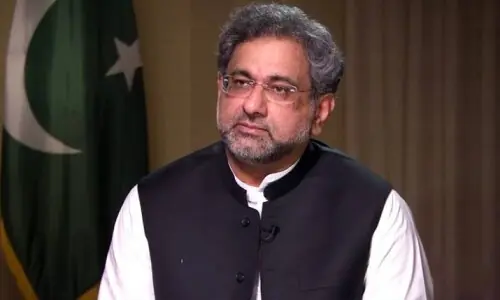
Zahid Ahmed has played a number of roles on television, ranging from the dependable hero to the sneaky villain, mastering accents and adding little gestures. But he seems always to be biding his time, waiting for that rare character that challenges and excites him…
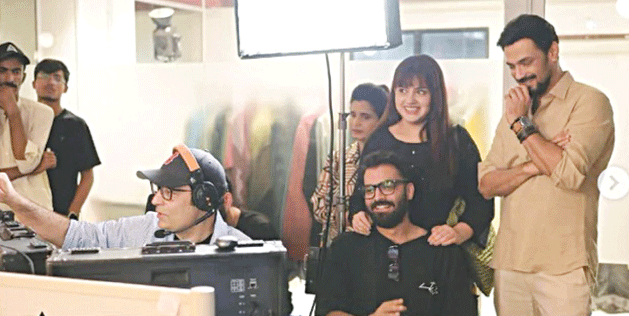
Titled Dil Dhoondta Hai Phir Wohi, the script has been written by Rida Bilal; Adnan Sarwar is directing and the drama is being co-produced by Express Entertainment and Asad Siddiqui’s fledgling Alpha Productions. Zahid and Zara Noor Abbas star as the leads. The shoot is half-way done — and Zahid thinks that it’s a great time to start a conversation on the story that will soon unfold on TV.
‘A story like no other’
“For the first time on Pakistani TV, we are touching upon the topic of frontotemporal dementia [FTD], a rare form of dementia which may occur amongst people in their 40s, with a life expectancy of usually eight to 10 years after diagnosis,” he says. “I play the man suffering from the disease, and I agreed to play the character even before I had read the entire script. Zara Noor Abbas called me and told me the story, and I was immediately on board.”

Zahid continues, “I got to read the whole script before shooting began. That rarely happens. Usually, we get to read a few episodes, while the rest of the script is still being written. If we insist, we will be given an approximate idea of what the rest of the story is likely to be. After Ishq Zeh-i-Naseeb, this was the first time that I got to read a drama’s entire script, and Rida Bilal has done an exceptional job handling a subject that is so gripping and sensitive.”
So, the subject was what convinced him to sign on to the drama?
“Yes, and also a few other factors. Firstly, the script, and then, Adnan Sarwar — the magnificent Adnan Sarwar — was going to be directing. When I met him, I showed him a message that I had sent to him online, back in 2015, when I was a struggling actor. I had just seen the movie Shah, and in his inbox there was still an unread message from me, telling him that I was a big fan and that I would love to work with him someday.
“Now, I finally have gotten that opportunity, and I hope that I do so again. The frames that he creates and the pace that he has maintained with the narrative are exceptional. It’s a heartbreaking topic, but Adnan has made sure that the story is told in a very interesting manner.
“Then, I have gotten the chance to work with Zara Noor Abbas, who I always thought is a brilliant actress but had never shared the screen with before. Lastly, this is Asad Siddiqui’s co-production with Express Entertainment, and I always have a soft corner for new producers trying to enter a very competitive market with ambition and passion. I was willing to go the extra mile for Asad — maybe charge a little less than my usual fee, use my own transport, bring my own food… although the food on the set is great!”
That’s always a great incentive, I quip to him, although, considering that he’s told me that he prefers to “eat lean”, perhaps Zahid doesn’t avail the full benefits of the great food on set! His main reason for signing on, of course, is that finally — finally — he’s getting to sink his teeth into a role that is probably very challenging.
“It’s been five years in the wait, since Ishq [IZN],” he agrees with me. “It has been a challenge because, for most roles, you tap into some feeling within yourself. To play a protagonist, you may think along the lines of morality and courage. For the antagonist, you could delve into the deepest, darkest demons within you. But how do you play someone who is rapidly forgetting everything, and doesn’t even know that he is forgetting?
“It may be something as small as not remembering that he has just had a cup of tea, to not being able to recognise his best friend, to forgetting motor skills, cognitive thinking, learned behaviour like how to drive a car or how to operate a laptop.”
He continues: “Before the shooting started, I put up posts on social media, reaching out to people who may know someone suffering from dementia. A lot of people responded and helped me out, sending me videos of their parents or other people that they knew who were going through it. They were all elderly people — FTD occurs among a younger age group — but I spent a lot of time observing their mannerisms, the way they looked at you when they had completely blanked out, but didn’t know that they had.”
Playing such a character must have been depressing, I comment to him. “I am able to switch off from character. Considering my preference for difficult, challenging roles, if I had been a method actor, I would have gone crazy by now!” he jokes. “But yes, it is a running joke in my home these days that, when I forget something, I tell my wife that I am going through dementia!”
Will it be a depressing watch? “It will be a thought-provoking one and I hope, an interesting one,” he says. “We live in a world where we get our thrills from a story well-told, and Rida Bilal and Adnan Sarwar have done an amazing job with the narration.
“We were treading a very fine line, depicting what a young person affected by dementia and his family go through, with sensitivity, without any over-dramatisation. The disease’s progression is shown very scarily, heartbreakingly, the deterioration that perhaps spans seven, eight years, depicted in about 25 episodes.
He adds: “The emotions had to be portrayed very carefully. My character is going through it, but doesn’t know that he is suffering. However, his wife goes through a lot of turmoil and there comes a time when she is a care-giver to two children — her husband, degenerating to infancy, and their 10-year-old son. Zara has done a great job, taking on such a difficult role.”
His ‘kind of role’
His role seems to be a difficult one too. But Zahid prefers it that way, doesn’t he?
“Yes,” he smiles. “I like to make life tough for myself. As long as my bank balance supports it, I want to be seen in projects that excite me. We are all here to make a living, but we are also artists, and I am always on the search for challenges.”
But that doesn’t always happen, does it? Good scripts and challenging roles in TV dramas are hard to come by, aren’t they?
He nods. “Yes, it does seem to be that way. And that’s the case around the world. All content is now measured on the basis of the numbers that they generate. Even in Hollywood, which is a juggernaut for generating content, the focus is now on commercial blockbusters, while the odd, critically acclaimed movie comes maybe once in two years. Earlier, such movies would release one after the other, but now producers would rather churn out superhero movies that bring in profits. It’s the same here. Art is being measured by numbers, which is why there has been a general decline in content.”
Do the numbers matter to him? “Only the ones in my bank account!” he declares.

And the bank account’s doing fine? “Yes,” he smiles, and adds, “It feels good when a drama that you have worked in gets high ratings, because that means that a lot more people are watching it. You feel happy for the producers because they are earning well from their investment. In my case, though, if you look at the drama for which I am most known for — Ishq Zeh-i-Naseeb— it never hauled in the kind of numbers that the massy, hit dramas do.
“It was still watched extensively, by people within Pakistan and abroad. Every actor has his or her own strength — some are known for their critically acclaimed work, and others for their commercial popularity.”
After the award
IZN also brought home a Best Actor trophy for Zahid. How does an actor’s career change after an LSA win? His answer is surprising: “In my case, after I got an award, I stopped getting work. So, a trophy looks good on your mantle, you feel happy that day and your Instagram blows up, but that’s it.”
He ponders this. “I don’t know why, I just felt that there was a lull after the LSA win. Perhaps producers felt that I only wanted to do certain kinds of roles. They would wonder 10 times whether a role was meaty enough to offer to me. And it is true — I do try to be selective when I can. Perhaps it was assumed that I would charge too much after winning the award.”
Do you, I ask him point blank.
“No, I only charge as much as others do,” he says. “Also, my LSA win came during the coronavirus pandemic. There was no big speech, no ceremony and work had more or less stopped during that time. Channels were not allowed to start any new project and things slowed down, for all actors.
“I remember in 2020, [producer] Sana Shahnawaz called me and offered me the drama Faryaad,and I grabbed at the role because, finally, I had some work to do. That was the follow-up role to Ishq Zeh-i-Naseeb. It was a desperate choice, but I enjoyed playing a character that was so evil, within this massive family set-up and with so many different tracks to the main storyline.”
It was certainly a surprising choice, I say. He nods.
“But then, you say you don’t remember any standout role of mine that came later — do you remember many such roles at all in recent times, that have driven the narrative of a drama? There have been a lot of great dramas but not many where a single character has stood out except, perhaps, Parizaad. Imran Ashraf Awan’s Bhola also came about around the same time as Ishq Zeh-i-Naseeb.”
Zahid continues: “One character that I really enjoyed playing was that of a tailor in the drama Mere Bunn Jao. I changed my voice and spoke in a particular accent and, while the drama itself had the usual story revolving around love and betrayal, I was happy with my role. When I look back at my career, I just want to see a colourful bouquet of different experiments.”
There have been several other roles of his that come to my mind. For instance, in the drama Gentleman, he plays a corrupt government officer. I observe that the role could have been really memorable, had the drama’s storyline been perhaps stronger.
“For me, it was a no-brainer to sign on to Gentleman,” he says. “When Humayun Saeed — one of the country’s biggest producers — calls you and says that he wants you for a role, when your bestie Yumna Zaidi is part of the cast, and the script is written by Khalilur Rehman Qamar, you immediately come on board. I was drawn to the idea of playing a corrupt bureaucrat who is successful in his machinations for some time before meeting his downfall.”
Most recently, there has been Hamraaz, where he plays a supportive, long-suffering husband, standing by his wife, played by Ayeza Khan, while the villain, Feroze Khan, wreaks havoc in their lives. Zahid may be the good guy in the drama but I tell him, quite honestly, that he is capable of much more than simply enacting the confused, supportive husband.
He responds: “I always knew that the antagonist had the meatier part in Hamraaz, but I was fine with my character being the source of comfort to his wife. I was working with a director who I trust blindly — Farooq Rind — who has an amazing body of work, some of it being with me. When he discussed the story with me, he gave me the confidence that it would be told in a balanced manner.
“Also, this was the first time that I worked with Geo Entertainment and 7th Sky Productions. There was an entire audience that I hadn’t yet tapped into, and Hamraaz gave me the opportunity to cross that bridge.”
Are there certain kinds of roles that he wouldn’t want to do? He promptly replies, “I definitely don’t want to play the forceful lover. Such stories don’t get made in educated societies but, even if they did, people would be able to analyse them. In a society like ours, though, which is already fascinated by aggression, it is a poison that supplements this way of thinking. And we all need to make a conscious choice to tell stories with responsibility.”
When the going gets tough
Does he also sometimes sign on to a role so that he simply remains visible? “I only want to be seen in good work,” he professes. “For me, the most tragic decision is to sign on to something simply because I need the money. If my motivation were to be seen more, I would be working three times as much as I do right now.”
He pauses. “There was a time when I was working a lot more than I do right now. For the first five years of my career, I would only be home on Sundays, and that too if I was lucky. I was busy establishing myself, making sure my career gained momentum and I got paid a certain rate.
“I am glad that I don’t have to work as frantically now. Maintaining a healthy work-life balance is very important. A lot of people think that they will work hard, save and then eventually bring up the quality of their lives. But in doing so, they lose out on time. Kids, when they grow up, won’t clap for how you worked on your craft. They will ask you where you were when they needed you.
“My sons are now nine and 10, and I love being home, playing on the Playstation with them, spending time with my wife, going to the movies. The mosque is near my house and I love praying there five times a day. I love my work but I do what I do in order to create a life for myself and my family.”
His inclination towards religion and prayer is something that he has often talked about passionately. Does religion keep him grounded in an insecure, highly competitive industry?
“Yes, because ultimately we will all be below the ground,” he says. “I don’t really believe in networking or unnecessarily flattering someone because I am hopeful that they will favour me. My networking is up there.” He points his finger towards the sky. “And it looks like that network is working fine.
“If something good is being written, I am being considered for it. That’s the network we all want on our side. The biggest award is to be considered for such roles. What more recognition do I need? That’s the kind of work that I have always been in search for.”
In a landscape dotted with run-of-the-mill stories, it is a search that only sometimes comes to fruition. And then, Zahid researches and practises and adds skin and bones to a character that has excited him. It is only then that he agrees to meet me for a conversation, to discuss a role that he can’t wait for the world to see.
I hope I get to meet him again soon.
Published in Dawn, ICON, September 14th, 2025