With massive floods posing a serious threat to the economy, prompting forecasts of GDP growth falling during FY26 and amidst a debate on whether new provinces should be created or local bodies should be democratically empowered, Defence Minister Khawaja Muhammad Asif has stressed the need for a robust third tier of government.
Addressing the Senate on Sept 1, he said, “A comprehensive and robust local government system is needed to serve the masses in the cities, villages and tehsils.” He regretted that presently there were no elected local body institutions in Punjab and other parts of the country.
Until political parties are compelled to hold regular local elections, devolve real financial powers and respect the people’s mandate, governance will remain broken, says public policy analyst Durdana Najam.
In an article titled ‘Pakistan doesn’t need provinces, it needs its Constitution’ published by The Express Tribune, Ms Najam stresses, “We need to honour the map already drawn by our Constitution. That is where resilience begins.”
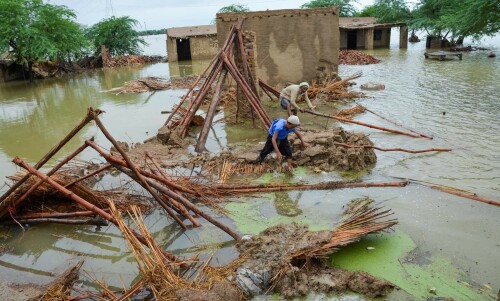
Describing the recent devastation caused by floods as ‘a man-made disaster’, the defence minister also suggested building hundreds of small dams and reservoirs, instead of waiting for decades to build mega projects, warning that water would become an extremely scarce commodity in the future.
Despite being battered by major floods every three to four years, Pakistan still lacks a precautionary or anticipatory investment strategy to mitigate the fallout
“Climate is a national, rather than international, issue, and it needs a national response,” Mr Asif stressed, regretting, “It was unfortunate that all big dams had been built by military dictators, while politicians had built hotels on riverbeds.”
The Lahore Chamber of Commerce and Industry has urged the government to immediately launch a nationwide programme for constructing rainwater harvesting dams to shield the country from recurring floods and looming droughts. The chamber has proposed a sustainable national programme with a Rs200-300 billion annual allocation under a public-private partnership, monitored through digital systems for transparency.
Describing the recent devastation caused by floods as ‘a man-made disaster’, Defence Minister Khawaja Muhammad Asif suggests building hundreds of small reservoirs, instead of waiting for decades to build mega projects
The World Bank has ranked Pakistan fifth among nations most affected by extreme weather events driven by climate change. Civil society professional Nasser Memon says disasters are triggered more by frequent and sustained bursts of misgovernance than cloudbursts.
Furthermore, analyst Niaz Murtaza says a crisis-weary nation can see an end to the recurrent crises only through political legitimacy based on fair polls and civilian sway.
Many analysts trace current crises to deviations from constitutional norms or say they occur when constitutional provisions are overlooked. The Human Rights Commission of Pakistan (HRCP) recently highlighted the necessity to enforce Article 9A of the Constitution to provide citizens with their right to clean air, safe drinking water, waste management, disaster preparedness and access to environmental justice.
Yet this vital right has remained absent from public debate, even as the country confronts a worsening climate and environmental crisis, said the HRCP statement.
Pakistan has suffered nearly 20 major flood disasters since 1950 — half of them in the last two decades. Despite being battered by major floods every three to four years, Dr Hafiz A. Pasha laments that Pakistan still lacks a precautionary or anticipatory investment strategy to mitigate the fallout. As devastating floods threaten to cripple agriculture, says Dr Pasha, the GDP growth for FY26 may drop to between zero and one per cent.
However, State Bank Governor Jameel Ahmed said on Sept 2 that the economy is positioned on a more stable footing, with growth projected between 3.25pc and 4.25pc in FY26.
Unfortunately, for many of the affected farmers — mostly smallholders — the devastation is total: with crops, livestock, homes and livelihoods all swept away, say analysts at Dawn. Left with nothing to invest in the next crop — let alone resources to live on — more people are likely to slip below the poverty line. The agriculture losses will be felt across industries.
More worrying, they add, is the impact to the fragile balance-of-payments situation, with the deluge likely to push up the import bill due to domestic shortages of food items. Exports, on the other hand, may suffer due to production losses in rice and cotton.
The trade deficit surged by 29pc to $6bn in the first two months of FY26 from $4.66bn in the same period the previous year. In August, exports of merchandise dropped by 12.49pc on a year-on-year basis.
That marked a contraction in the last five months, with only July recording a growth of 16.9pc. In the first two months of this fiscal year, the import bill increased by 14.23pc to $11.2bn from $9.73bn on a year-on-year basis.
Not only that, the government lacks the resources to undertake any major national reconstruction programme and has allocated only 2pc of Public Sector Development Programme funds for new schemes in the current budget.
While briefing the Senate Standing Committee on Planning and Development, Secretary of Planning and Development Awais Manzur Sumra said the International Monetary Fund had demanded that new development projects be limited to 10pc of the PSDP to maintain fiscal discipline, given the already large and longstanding project portfolio. An International Monetary Fund Diagnosis Report had pointed out weak project prioritisation, frequent delays, cost overruns, and inadequate protection of funds for approved projects as major shortcomings.
Published in Dawn, The Business and Finance Weekly, September 8th, 2025