Divides within



FIFTY years on, in the area that once comprised West Pakistan and the territories under its jurisdiction, we see a new era that is reminiscent of the pre-1971 east-west divide in terms of poverty, underdevelopment, unrest and violence. In geographical terms, the east, in this context, comprises Punjab, Sindh and Azad Kashmir, and the west Balochistan, KP and Gilgit-Baltistan. River Indus roughly spans their borders.
But in this case, the eastern side is comparatively richer, stronger and safer than the western one, which has seen greater poverty, conflict and neglect. While rural Sindh and the Seraiki belt are indeed experiencing poverty, the per average per capita income in the geographical east is higher. The area roughly west of the Indus has most of our poorest districts, while the one to its east holds almost all top districts, businesses and jobs. Sindh- or Punjab-based parties or a Punjab-dominated establishment always hog federal power.
There are other divides too. The eastern groups mainly speak Indo-Aryan dialects while western ones mainly use Indo-Iranian and Tibetan ones. Pre-partition, the former had been India’s core part for millennia. At the other end, Balochistan, though under the British, consisted of princely states and what is now KP saw some periods of Afghan rule. This western side of the Indus was seen as more rural, tribal and conservative. Nature was responsible for greater poverty in areas west of the Indus. As KP and GB are hilly and Balochistan is arid, they lack the large crop yields of the irrigated plains in Punjab and Sindh.
But political will and technology can easily trump nature to ensure equity. Given strongly felt national ties, the former West Germany funded the eastern part after the merger. So, the lag here is due to politics. This issue can turn small physical and social divides into bigger problems. The seeds of the sequel were sown as a sub-plot in the old east vs west tale. The elected ex-NWFP set-up was fired in 1947. Balochistan joined us, through the assent of its chiefs, without the popular support witnessed in the other parts. It lacked an assembly until 1971. GB too was ruled centrally.
The state’s response has only been force.
Pakistan’s first era ended in separation in 1971 due to usurped political rights and military action. The key link to the sequel was oddly a ‘socialist democrat’ who co-drove the last nail in the coffin of the old east-west era and then laid the first brick of east vs west gripes. Showing no remorse just two years on, Bhutto revisited the older sins: military action and not upholding democracy. Balochistan’s first elected set-up lasted nine months. The next one didn’t reach term either. Over 50 years, more such bricks were laid by an establishment-dominated state to erect a rising wall.
Today, KP and Balochistan endure endless violence while GB seethes with dissent. But a force-focused, security state eschews democratic politics, as seen in planned operations in former Fata. Past such actions didn’t end terrorism; in fact, they hurt civilians who rightly oppose new operations now. A new policy must avoid large-scale operations and drone attacks; it must involve local leaders fully, free dissidents, ensure progress, boost border control without harming civilians, target all militants equally, and use commando action to avoid civilian uprooting and losses.
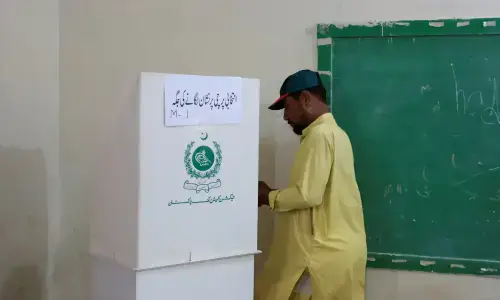
Matters in Balochistan are getting out of hand as the insurgency gains strength. The state’s only response is force, when what is needed are new fair polls, the release of dissidents, an end to abductions and accountability for past ones, investment in poor areas via local leaders, and the offer of sincere talks to those insurgents that are not among the intractable ones.
In GB too, dissent is rising and it urgently needs full rights. There is also ire as revenues raised from its natural resources don’t accrue to its people.
The state has a new interest in mining in league with the US, the global usurper of natural wealth and fickle ally of autocrats. But most mines are based in the western parts, yet the state is adopting a top-down policy that trumps local interests. This will only increase violence. Mineral wealth usually harms poorly run, divided states like ours.
It’s bizarre that a state that won freedom via political talks has avoided politics and used force freely against the very federating units whose assent made it free. But society in Pakistan is too free-minded to accept force. Pre-1971 Pakistan lasted just 25 years due to the use of force. Fifty years on, the country is again restive. Only fair polls, civilian sway and political reconciliation can yield a prosperous, secure country.
The writer has a PhD from the University of California, Berkeley, in political economy and 25 years of grassroots to senior-level experiences across 50 countries.
Published in Dawn, August 5th, 2025