0
0
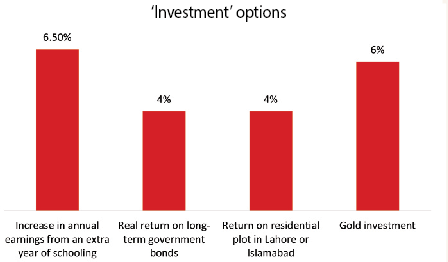
An interview with The Citizen Foundation’s (TCF) CEO revealed that parents, even from the lowest economic classes, are eager to ensure their children receive an education. While education can ensure that those who exit the TCF community can earn a multiple of their household income, how do returns on education in Pakistan compare with those in other countries or even other forms of investment?
In an Economic Advisory Group brief, “Education Disaster: Nowhere To Go For Many,” the authors estimate that the average return on education in Pakistan is 6.5pc, roughly that of investing in gold. The marginal increase in investing in education compared to other forms of investment suggests a lack of economic opportunities in a country with one of the highest youth populations in the world.
Globally, an additional year of schooling boosts annual income by 8.8pc. The higher the returns to education, the higher the potential for its transformative performance. However, the study estimates that returns to schooling fall to 2pc or less in 40 out of 126 districts surveyed.
The return to education also depends on the industry in which a person is working. For example, a maid with education up to grade four may not be paid significantly more than one who cannot read or write. So what is the economic argument for the families to invest in her education? And this can be the case for all levels of education.
A brief by the Pakistan Institute of Development Economics, “Disaggregating The Graduate Unemployment in Pakistan”, states that graduate unemployment is almost three times the average unemployment rate. There are few jobs for the degrees being offered, while the number of people looking for jobs increases the labour force.
Yes, parents should educate children because its benefits are far more holistic than just an economic equation. Nor are our returns on education directly comparable to returns on investment. However, the economy needs to evolve from low-complexity, low-value-added production so that it can employ the educated.
Published in Dawn, The Business and Finance Weekly, July 14th, 2025