AT a time when bellicosity — most of it originating in New Delhi — is drowning out rational discourse in the subcontinent, sanity must be given room.
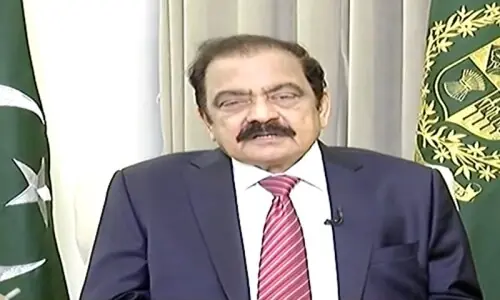
Early on Wednesday, Pakistan’s federal information minister said that India could be “planning something” within a day or two. On Tuesday, Deputy Prime Minister Ishaq Dar had told the Senate that New Delhi was preparing “some form of escalation”. These warnings take on added significance when the Indian PM’s instructions giving “operational freedom” to his military are taken into account. And it is not mere words that are causing alarm; things on the ground are also heating up.
In the days following the Pahalgam tragedy, there has been regular crossfire across the LoC, while the military shot down two Indian quadcopters in AJK on Tuesday. Moreover, state media had reported that Indian warplanes had been patrolling near the LoC when they were confronted by PAF jets. On Wednesday evening, Mr Dar, along with the ISPR head and FO spokesperson, reiterated that Pakistan would respond if provoked.
India continues beating the war drums despite no credible evidence linking Pakistan to the Pahalgam tragedy. This dangerous brinkmanship can have devastating consequences for South Asia, and it is highly irresponsible of the Indian state and large sections of the Indian media to whip up war hysteria in a nuclear neighbourhood. It bears repeating that if India has any solid evidence, it should share it with Pakistan and the rest of the world.
Moreover, if New Delhi is confident of its assertions, it should agree to have a neutral third party investigate the attack. Clearly, due to the lack of any plausible evidence against Pakistan, India is trying to manufacture a crisis. This is a highly dangerous game which can have unpredictable ramifications for the entire region.
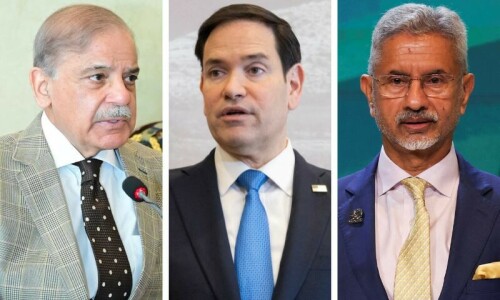
The UN chief has offered his good offices to avoid a fresh conflagration. Both sides need to take up this offer to prevent the march to war. Other common friends, such as the Gulf states, the US and Russia, can also play a part in bringing temperatures down. In this respect, the US secretary of state talked to PM Shehbaz Sharif yesterday. Nearly eight decades of hostility have given nothing positive to the region. Once the war hysteria lessens, India must calm down to consider the merits of talking to Pakistan regarding all issues — including Kashmir — if it is serious about peace. Pakistan can and will defend itself against Indian aggression, but any military engagement will result in more death and destruction for the entire region. Therefore, New Delhi must change its belligerent tone and work to resolve this crisis with statesmanship, which has been sorely missing under the BJP set-up. The window for a peaceful resolution may be closing fast.
Published in Dawn, May 1st, 2025