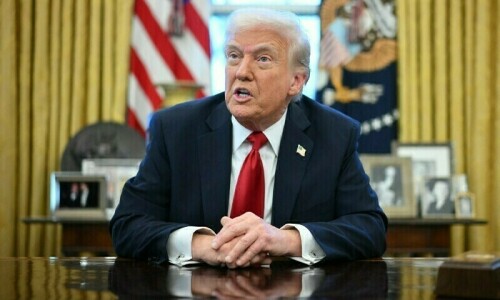
“If Trump has his way, the United States will lose its global influence, standards of living of Americans will decrease, including for those who supported him, and the world will not be safer, more secure or more prosperous.” This is the considered view of Nobel Prize winner Joseph E. Stiglitz as expressed in his latest book ‘Globalisation and its Discontents Revisited: Anti-globalisation in the Era of Trump’.
Looking at the latest developments, Mr Stiglitz’s views are supported by observers who say that two top foreign policy priorities — ending the wars in Gaza and Ukraine — both appear mired in the kind of messy details and conflicting agendas that often obstruct lasting peace.
Mr Stiglitz hopes that the United States and the world will emerge from this episode with a greater resolve to create fairer and better globalisation, as he has long advocated.
Protests citing grievances against
Trump’s agenda, ranging from social to economic issues, were held in all 50 US states on April 5.
In the early 1970s, it may be recalled, the emerging strategy for people-centric economic development was replaced by the now-faltering West-led financial globalisation, with most economies finally hit by the balance of payment crises and widening disparity in incomes among them and within nations.
As Trump’s protectionist policies shake global order, experts warn of deepening inequality, economic instability, and diminishing US global influence
To end the global disorder, the time has come for public policies to shift towards evolving growth and development strategies for people’s welfare, with the international community extending mutual cooperation for their step-by-step implementation.
It is also clear from the US’s tariff policies that US-driven financial globalisation has also become counterproductive over time in many ways for the American economy.
When elite wealth outpaces economic growth and capital flows into unproductive sectors, it deepens inequality and stifles real progress, says analyst Ali Asad Sabir of the Lahore University of Management Sciences.
That is evident from the narrative in the book titled ‘The Lords of Easy Money: How the Federal Reserve Broke the American Economy’, by Christopher Leonard, business journalist of The New York Times.
In many important ways, he writes that the financial crash of 2008 never ended. It was a long crash that crippled the economy for years.
The dollar, for decades a safe haven, fell about 1.7pc on April 3, its highest daily drop since November 2022, after President Trump imposed tariffs on imports
The problems that caused it were almost unsolved. And the financial crash was accompanied by a long crash in the strength of the American democratic institutions.
When America relied on the Federal Reserve to address its economic problems, it relied on a deeply flawed tool. All the Fed’s money only widened the distance between winners and losers and laid the foundation for instability. “The value of workers had been diminished, but the value of other commodities was on the rise. The Fed was making sure of it,” observes Mr Leonard.
Trump has also opened up so many fronts, confronting foes and friends alike and upsetting domestic stakeholders with unilateral actions that tend more to destabilise the existing order rather than help build a new one.
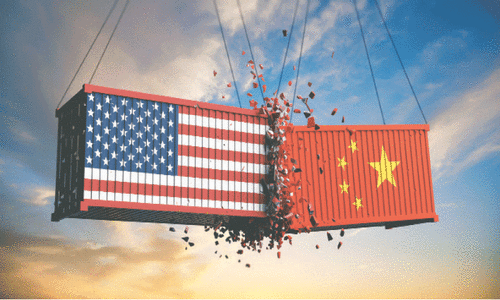
Experts warn the tariff move risks triggering a recession at home and sparking a trade war. “If this trade war continues through
Labour Day [September 1], the US economy will likely suffer a recession this year,” Mark Zandi, chief economist of Moody’s Analytics, told AFP.
The dollar, for decades a safe haven, fell about 1.7pc on April 3, its highest daily drop since November 2022, after President Trump imposed tariffs on imports. Stock markets also tanked as tariffs ignited recession worries.
Left unchecked, a crisis of confidence in the dollar could also undermine its position as the world’s reserve currency, according to market commentaries.
The likely implementation of US tariffs imposed on April 2 can be seen as “the start of a march towards Europe’s independence”, European Central Bank head Christine Lagarde told France Inter radio.
The US administration’s not-so-secret plan is also to rebalance trade by weakening the dollar, analysts say, adding a way to do that would be to enlist foreign central banks in a coordinated effort to revalue their own currencies.
Dwelling on Trump, tariffs and the fate of the dollar, Scottish-American political economist Mark Blyth argues that America’s protectionist policies reflect a global economic reordering that was already underway.
Minutes before the markets opened in New York on April 7, Trump said his tariff reforms were “a chance to do something that should have been done decades ago”. “Don’t be weak! Don’t be stupid! Be strong, courageous, and patient, and greatness will be the result!” he urged.
A full-blown war is upon us as the era of the rule-based multilateral trading order is nearly over, say analysts at Dawn. The American leader has made it clear that he would not make a deal with other countries unless the trade deficit is solved.
Optimism is welcome, but we must be prepared to brace ourselves for the possible shocks.
Published in Dawn, The Business and Finance Weekly, April 14th, 2025