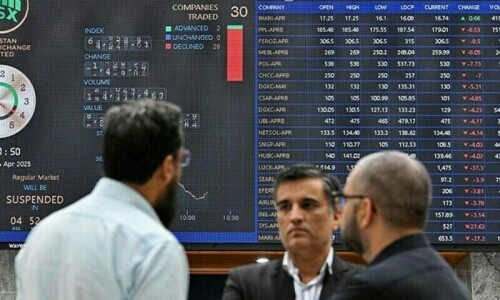
A bearish trend gripped the Pakistan Stock Exchange (PSX) again on Friday as the market declined by over 1,300 points after the positive sentiments that drove the bourse staging a recovery a day earlier were blown away by the ongoing tariff war.
The dip followed China saying it would raise tariffs on US goods to 125 per cent.
The benchmark KSE-100 index declined by 1,335.88 points, or 1.15pc, to close at 114,853.33 from the previous close of 116,189.21.
Yousuf M. Farooq, director research at Chase Securities, said the market closed lower today as participants reassessed the broader implications of US tariffs — particularly their impact on global trade dynamics and China. “While the initial reaction suggested that some Pakistani exporters might benefit from improved access to the US market, attention is now shifting to second-round effects, including the risk of a slowdown in other export-driven economies due to increased competition from China,” he added.
Farooq said Pakistan remains relatively insulated from direct fallout, given its limited export base and the recent sharp drop in global commodity prices. “However, for this to translate into a net positive, low commodity prices must be sustained. If that occurs, the central bank would have room to gradually cut interest rates, potentially leading to a rerating of equities through higher price-to-earnings multiples,” he explained.
Awais Ashraf, research director at AKD Securities, said investors were worried about concerns over the escalating US-China tariff war after Beijing raised its tariffs in retaliation.
However, he pointed out that falling commodity prices, particularly oil, would be beneficial for import-dependent countries such as Pakistan. “Falling prices will ease import bill while lowering inflation which will help in further monetary easing,” he explained.
US President Donald Trump has deployed sweeping tariffs, including painfully higher levies for dozens of major economies, as a stick to force manufacturers to base themselves in the US and for countries to lower barriers to US goods.
But following market turmoil this week, he blinked first in his push to remodel the post-war system of global commerce and froze many tariffs for 90 days, although he raised them for China to a staggering total of 145pc.
Beijing’s latest round of retaliation brings its levies to 125pc, effective on Saturday. However, the Chinese finance ministry said further action by the US would be ignored because “at the current tariff level, there is no possibility of market acceptance for US goods exported to China”.