Prisoners to return ‘in coffins’ if Israel uses force, Hamas warns


DOHA: Hamas warned on Wednesday that Israeli prisoners may be killed if Tel Aviv attempts to retrieve them by force and air strikes continue in the Gaza Strip.
The group said in a statement that it was “doing everything possible to keep the occupation’s captives alive, but the random Zionist bombardment is endangering their lives”.
“Every time the occupation attempts to retrieve its captives by force, it ends up bringing them back in coffins,” it said.
Meanwhile, Israeli Prime Minister Benjamin Netanyahu threatened on Wednesday to seize parts of Gaza if Hamas does not release prisoners.
The Israeli prime minister threatens to capture parts of Gaza Strip if Hamas does not agree to free prisoners
Netanyahu told parliament that “the more Hamas persists in its refusal to release our hostages (prisoners), the stronger the pressure we will exert”.
“This includes the seizure of territories, along with other measures I will not elaborate here,” he added, days after his Defence Minister Israel Katz had warned: “The more Hamas refuses to free the hostages (prisoners), the more territory it will lose, which will be annexed by Israel.”
Just over a week since Israel resumed operations following a January truce, Israel said two projectiles were fired from the Gaza Strip, with one intercepted and the other landing near the border.
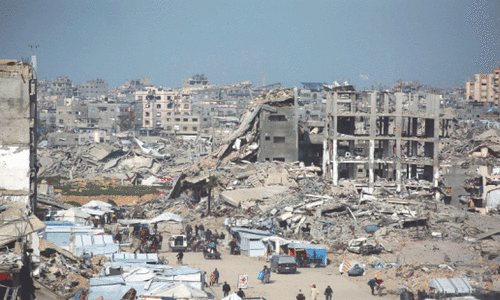
Shattering weeks of relative calm brought by the fragile ceasefire, Israel last week resumed intense bombardment and ground operations across Gaza, while Hamas returned to launching rocket attacks.
Israeli officials say the resumption of operations was meant to pressure Hamas into releasing the remaining prisoners, after a stalemate in talks with mediators on extending the truce — which saw 33 Israelis freed in exchange for Palestinian prisoners.
Israel wanted an extension of the truce’s initial phase, while Hamas demanded talks on a second stage that was meant to lead to a permanent ceasefire.
Israel restarted intense air strikes across the densely populated Gaza Strip last week followed by ground operations, shattering the relative calm afforded by a January ceasefire with Hamas.
Published in Dawn, March 27th, 2025