Economic dilemma



IN his recent address to parliament, the finance minister stated that he would resist any pressure to revive growth, presumably until the necessary reforms were completed and economic stability fully restored.
This firm stand, however, was questioned by some critics who asked why he was further building reserves based on high-interest commercial loans. Is this a sign that the economic stability the government claims it has achieved in a short period is simply a mirage?
There is a large element of truth in this. Governments previously have been quick to announce that the economy has stabilised and then fallen on their faces when hit by an internal or external shock. But this debate raises two questions. First, when can one really claim that the economy has stabilised enough to reignite growth? Second, how long can the finance minister wait to restart growth, despite his current stance?
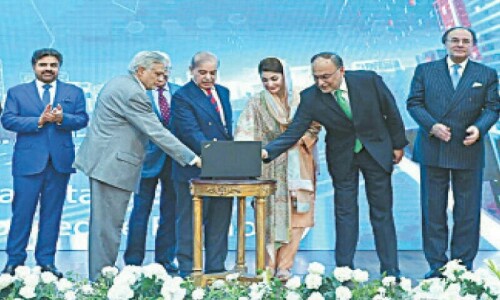
Let us address the second question first. Not long. A political government that has come to power on shaky grounds must show results, especially given the sharp rise in poverty post-Covid-19, an angry middle class whose numbers are fast dwindling, and a youth bulge facing joblessness. Then there are rosy promises being made by the government every day, the most recent of which is Uraan Pakistan with its ambitious target of rapidly raising per capita income and converting Pakistan into an economic power in the next 10 years. With no tail wind, can Uraan Pakistan take off?
So, how long must the finance minister resist the temptation to rekindle growth? He must be aware of the growing pressure and is taking all precautionary steps by building up foreign exchange reserves so that, if push comes to shove, he has enough to at least gradually press on the accelerator.
We have not even begun to introduce structural changes.
But before he can even contemplate this step, he must raise revenues. At Davos, he claimed he would raise the tax-to-GDP ratio from just over nine per cent to near 13.5pc over the next year or two (without precisely defining when). If having FBR officials drive about in new cars (and luckily not fly in helicopters) can achieve this, it would indeed be worth the cost. But he must also be aware that raising the tax-to-GDP ratio in a stagnant economy reeling from a very high bout of inflation is far more difficult than in a growing economy.
Turning to the first question: when will we know the economy has stabilised enough to move towards reviving growth? Briefly, when the IMF allows us to do so. Lest we forget, we are under a three-year IMF programme that was signed just four months ago.
The long answer is more complex. Let us examine the last time we tried to revive the economy in 2021-22 after Covid-19 left the economy at a standstill. The premise was that we had reserves of near $20 billion and the target growth rate set in the budget was modest at 4.5pc. But then the heavens opened. The economy grew that year by over 6pc and foreign exchange reserves fell to half. The then experienced finance secretary, Waqar Masood, warned against this rapid rise in imports (mainly of raw materials), but the State Bank, which should have known better, after drastically reducing interest rates, maintained a deafening silence. The change in government did not help. The rest, as they say, is history.
What the current government hopes is to learn from this experience under IMF tutelage. It believes its newfound stability and the sharp decline in inflation, which has allowed the huge fall in interest rates, will bolster business confidence and trigger a private sector-led growth revival on the back of much-awaited foreign investment. This has not happened so far. Large-scale manufacturing remains in the doldrums, the weather gods have deserted us and we may face a wheat shortage crisis. The business sector as always, never satisfied, clamours for further rapid reduction in interest rates.
But the real dilemma the economy faces is more fundamental. The process of bringing about basic structural changes in the economy has not even begun. So far, we have been only scratching the surface. On raising revenues, all we have done is to increase taxes on the already taxed. Industry still enjoys subsidised inputs. Losses in energy distribution continue. Our current account surplus is being driven by remittances with imports shooting up. And our traditional lenders (China, Saudi Arabia) are reluctant to lend more.
In the meantime, let the finance minister build up foreign exchange reserves in case he is forced to push down on the growth accelerator. For the economy to turn around on its own momentum on a sustainable growth path could be a very long wait!
The writer is a professor of economics at the Lahore School of Economics and former vice-chancellor of the Pakistan Institute of Development Economics.
Published in Dawn, February 2nd, 2025