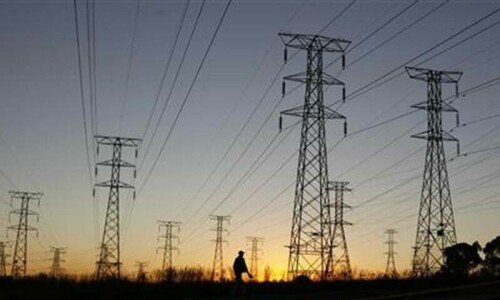
Tangled wires crisscross the streets in many parts of Karachi, forming a chaotic web overhead. It’s almost impossible to discern the purpose of each cable as they hang carelessly, draping over trees, poles, and buildings, contributing to the city’s already overwhelming visual clutter.
Amid this disorder, countless kundas — illegal connections used to steal electricity — are common. In a country where disputes over electricity bills can escalate to tragic extremes, like a recent case where an older brother killed his younger sibling over a bill of just Rs30,000, it’s not hard to understand why some might resort to such desperate measures.
However, transmission & distribution (T&D) losses have added many billions of rupees to the circular debt which in turn pushes electricity tariffs up. Quoting statistics from the National Electric Power Regulatory Authority (Nepra), a World Bank report compares Pakistan’s T&D’s losses at around 16.5pc in FY23 to 3.4pc in South Korea, 5pc in the United States, and 4.5pc in China.
Other than the high cost of power generation, the ageing infrastructure and weak governance have led to the growing circular debt. In the last fiscal year, Rs160.4bn were added to the circular debt, with the biggest share coming from Peshawar Electric Supply Company , Lahore Electric Supply Company, Quetta Electric Supply Company, and Sukkur Electric Power Company, according to the report ‘Pakistan Development Update — The Dynamics of Power Sector Distribution Reforms’. In FY24, the T&D losses climbed to 18.31pc, increasing the roughly Rs2.3tr debt by Rs276bn.
T&D losses can be separated into technical and non-technical categories. Technical losses stem from inefficiencies in distribution lines and power transformers, while non-technical losses include theft, vandalism, poor meter reading, and administrative problems. Illegal connections and theft compromise the safety of the electricity network and impair the provision of power to an area.
While an array of complaints can be laid at K-Electric’s doorstep, it has brought down its losses after it was privatised. In 2009, its aggregate technical and commercial losses stood at 43pc but went down to 21pc in 2023, and its T&D losses decreased from 35pc in 2009 to 15.3pc in 2023.
Mounting financial pressures and operational inefficiencies contribute to the rising circular debt, undermining the energy sector’s viability. Adding to the problem is a lack of diverse power generation technologies and poor long-term planning, both of which continue to drive up electricity costs.
Published in Dawn, The Business and Finance Weekly, December 2nd, 2024