Army chief seeks stricter rules for social media


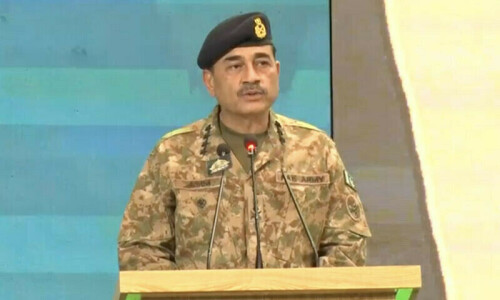
ISLAMABAD: Army Chief General Asim Munir on Friday observed that unrestricted freedom of speech was leading to the degradation of moral values in all societies.
In wide-ranging remarks at the Margalla Dialogue, hosted by the Islamabad Policy Research Institute, subjects such as India’s Hindutva ideology, occupied Kashmir, Pakistan’s role in peacekeeping missions, terrorism from Afghan soil, border management, freedom of speech, false information, etc all came up.
The army chief reaffirmed Pakistan’s commitment to remaining neutral in international conflicts and staying away from bloc politics while continuing its role in fostering global peace and stability.
Addressing the growing issue of fake news, he said, “While technology has played a pivotal role in the dissemination of information, the spread of misleading and incorrect information has become a significant challenge.”
Says country will stay away from bloc politics; speaks of TTP’s potential threat beyond Pakistan’s borders
“Without comprehensive laws and regulations, false and misleading information, along with hate speech, will continue to destabilise political and social structures,” Gen Munir stated, advocating for stricter regulation of social media and a reduction in online freedoms.
Interestingly, the session featuring Gen Munir’s remarks was held a day after the two-day conference officially concluded.
The audience comprised members of the diplomatic community, serving military officials, and representatives from Islamabad-based think tanks.
Non-alignment policy
The event served as a platform for the army chief to reiterate Pakistan’s long-standing policy of non-alignment, as he said, “We will not become part of any global conflict but will continue to play our role for peace and stability in the world.”
Pakistan’s policy of avoiding bloc politics has been a consistent part of its foreign policy. However, the timing of this renewed emphasis is significant, coinciding with Washington’s preparations for a transition following Donald Trump’s victory in the US presidential election.
The escalating rivalry between the US and China remains the defining global competition of the current era, with profound implications for international alliances, economic systems, and strategic stability. This high-stakes contest is shaping the future of global governance and international order.
Gen Munir’s message was apparently addressed to both Washington and Beijing, emphasising Pakistan’s commitment to peace and neutrality.
However, notably absent from the publicly shared details of his speech was any mention of the China-Pakistan Economic Corridor.
The army chief focused instead on Pakistan’s broader contributions to global peace and stability. He highlighted Pakistan’s significant role in the UN peacekeeping missions, noting that 235,000 Pakistanis have served in these missions, with 181 making the ultimate sacrifice.
In a pointed message to the West, particularly the United States, the army chief underscored that the extremist ideology espoused by India’s ruling junta is not only a threat to Pakistan but also poses risks to Indian-origin citizens in America, the UK, and Canada.
While speaking about India’s ongoing atrocities in occupied Jammu and Kashmir, Gen Munir described these actions as an extension of the Hindutva ideology.
“The resolution of the Kashmir dispute, in accordance with United Nations resolutions and the aspirations of the Kashmiri people, is inevitable,” he asserted.
Addressing the terrorism threat from Afghanistan, Gen Munir emphasised Pakistan’s expectation that the Taliban administration would prevent the use of Afghan territory for terrorist activities and take stringent measures to curb such threats.
“A comprehensive border management regime has been established to secure our western borders,” he stated, highlighting Pakistan’s efforts to prevent unauthorised cross-border movement.
He also warned about the potential for the banned TTP to evolve into a threat beyond Pakistan’s borders.
Referring to the proscribed group as Fitna al-Khawarij, he pointed out its connections to several international terrorist organisations and proxies.
Published in Dawn, November 16th, 2024