Pakistan gets 5 bids from Chinese firms to help with Panda bonds: report


 0
0


Pakistan has received five bids from Chinese firms to help it raise funds via Panda bonds on Thursday, a Bloomberg report confirmed.
Panda bonds are a type of debt security issued by foreign entities in the Chinese capital markets, and they are denominated in Chinese yuan (RMB). These bonds allow foreign issuers, including multinational corporations, international financial institutions, and sovereign governments, to access capital from Chinese investors.
“The government had gotten three offers from law firms and two from credit rating agencies by the time its deadline for proposals expired,” the report said, adding that two local firms had also shown interest in working as “domestic legal counsels for issuing the bonds”.
Bloomberg said that the finance ministry “was evaluating the proposals before making a final selection”.
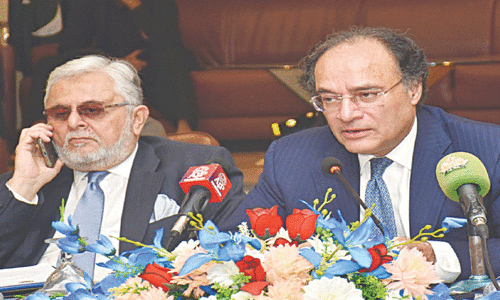
The country is keen to tap Chinese investors by selling as much as $300 million in panda bonds for the first time ever this year, Finance Minister Muhammad Aurangzeb had said in March.
In an interview with Bloomberg, the minister said that selling yuan-denominated debt would allow Pakistan to diversify its funding sources and reach investors in a new market.
“It’s something we should have looked at quite frankly some time back”, he was quoted as saying by the Associated Press of Pakistan (APP).
This news comes after the country entered a three-year, $7 billion aid package deal with the International Monetary Fund (IMF), which needs to be validated by the Fund’s Executive Board to enable Pakistan to “cement macroeconomic stability and create conditions for stronger, more inclusive and resilient growth”.
Earlier this week, global rating agency Fitch also upgraded Pakistan’s long-term foreign-currency issuer default rating (IDR) to CCC+ from CCC on the back of the country’s deal, while Standard and Poor (S&P) maintained its rating of CCC+.
‘Reforms necessary for the IMF programme to be the last one’
Finance Minister Muhammad Aurangzeb said that structural reforms could not be deferred any more, especially if the country wanted the current IMF programme to be the last one.
“It is not only about getting the fund, but making sure that this time around we do the structural reforms,” the finance minister said, “If you want to make this the last programme of the Fund.”
Aurangzeb said that “permanence” was needed to stabilise the country through reforms, adding that whether it was from the taxation, energy, or state-owned entities (SOEs) side, they “have to move forward”.
“Because we do not have the space and we do not have the room anymore to defer from this agenda,” he stressed.
Regarding capital markets, the finance minister said that a “Road to Market” was also necessary to make this the last Fund programme.
“And the Road to Market has to be through export-led growth and has to be through foreign direct investment which comes in for export-led industries,” he said, adding that they could not “borrow from the outside and create currency mismatches”.
“So, if you’re going to borrow from the outside, it has to be for the project which in return can actually produce foreign currency for the country,” he said, before adding Pakistan also needed “access back into the international capital markets”.
“Equity and the debt markets have to come into the fold so we can diversify the funding base when we go forward,” he stated.