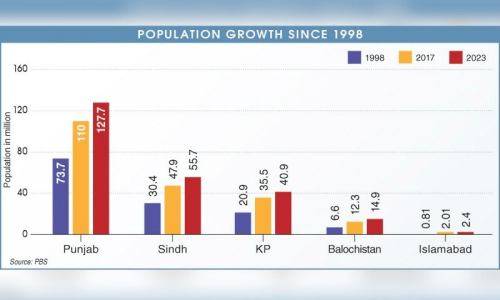
PAKISTAN is the world’s fifth most populous nation, yet the resources and socioeconomic tools needed to provide for over 240m souls are severely lacking. The only logical measure is to bring down the fertility rate in order to provide a better standard of living to citizens, as well as the generations to come. Unfortunately, successive governments, beyond providing lip service, have failed to act to prevent the population bomb from coming close to detonation. If we continue on this trajectory, the UNFPA projects that Pakistan’s population may hit 263m by 2030, which is just around the corner. Does Pakistan have the resources to adequately feed, clothe, educate and house this massive number? The answer is worryingly self-evident.
Therefore, today, as World Population Day is being observed globally, both state and civil society must pledge to address the population issue in a progressive and sagacious manner. This can be done by declaring a ‘population emergency’, and committing funds and efforts to the cause of addressing the explosive population growth. While some states have taken invasive steps, such as limiting the number of children couples can have, there are better examples in the neighbourhood that do not infringe on personal rights, yet achieve the goal of planned families.
In this regard, UNFPA cites the Muslim-majority states of Turkiye, Iran and Bangladesh, which have managed to implement successful family planning programmes. As per the UN body’s research, these countries succeeded because the state was fully supporting policies aimed at reducing population growth, while information and family planning services were easily available to citizens. There is no reason why Pakistan — which in the 1960s had initiated similar plans — cannot learn from these Muslim states, with which we share many cultural similarities.
Perhaps the biggest factor that can give a boost to family planning campaigns is unwavering commitment from the state at the federal and provincial levels. There needs to be buy-in from political parties, as well as the clergy.
The fact is that due to the social structures in Pakistan, it is imperative to have ulema, tribal elders and other community leaders on board to successfully implement family planning programmes — from big cities to the furthest hamlets. Both men and women need to be counselled about the options available. Moreover, successful programmes, such as Lady Health Workers, can be utilised to provide information and reproductive health services to women.
At the policy level, the skewed weightage given to large populations in the NFC Award formula should be reconsidered, as provincial administrations will continue to ignore rampant population growth in order to secure more funds. For a balanced future where all Pakistanis have access to food, water and basic services, a successful family planning model is essential.
Published in Dawn, July 11th, 2024