0
0
More than seven per cent of all deaths in 10 of India’s biggest cities are linked to air pollution, a large study said on Thursday, leading researchers to call for action to save tens of thousands of lives a year.
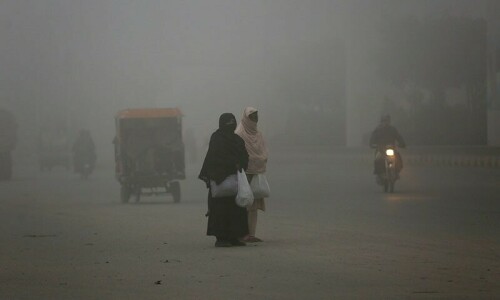
Smog-filled Indian cities including the capital Delhi suffer from some of the world’s worst air pollution, choking the lungs of residents and posing a rising threat to health still being revealed by researchers.
For the new study, an Indian-led team looked at the levels of cancer-causing microparticles known as PM2.5 pollutants in the cities of Ahmedabad, Bengaluru, Chennai, Delhi, Hyderabad, Kolkata, Mumbai, Pune, Shimla and Varanasi.
From 2008 to 2019, more than 33,000 deaths a year could be attributed to PM2.5 exposure above the World Health Organisation’s recommendation of 15 micrograms per cubic metre, the study said.
That represents 7.2pc of the recorded deaths in those cities during that period, according to the study in The Lancet Planetary Health journal.
India’s capital Delhi was the worst offender, with 12,000 annual deaths linked to air pollution — or 11.5pc of the total.
But even cities where air pollution is not thought to be as bad — such as Mumbai, Kolkata, and Chennai — had high death rates, the researchers emphasised.
They called for India’s air quality standards to be toughened.
The country’s current recommendation is 60 micrograms of PM2.5 per cubic metre, which is four times higher than the WHO’s guidelines.
Lowering and enforcing the limit “will save tens of thousands of lives per year,” study co-author Joel Schwartz of Harvard University said.
“Methods for controlling pollution exist and are used elsewhere. They urgently need to be applied in India,” he said in a statement.
The WHO says that almost everyone on Earth breathes in more than the recommended amount of air pollution, which can trigger strokes, heart disease, lung cancer, and other respiratory diseases.