0
0

KARACHI: The Universal Declaration of Human Rights and the International Covenant on Civil and Political Rights are very clear; civilians should not be tried by military courts, Amnesty International’s Secretary General Dr Agnès Callamard said.
In an exclusive interview with Dawn, the Amnesty chief — who is on her first regional visit to South Asia — said that although military trials for civilians are a “no-no” under international law, “sadly it has happened throughout Pakistan’s political history… [and] is not a novelty”.
Speaking to Dawn, Dr Callamard emphasised the principles of transparency, due process and judicial independence, urging Pakistan to uphold its international obligations and safeguard constitutional guarantees ensuring the right to a fair trial.
“The use of military courts is threatening the constitutionality of what’s happening right now,” she said.
Regarding the ban on X (formerly Twitter), Dr Callamard said Amnesty was quite alarmed by the shrinking space for freedom of expression in Pakistan.
Calling the ban “disproportionate, unnecessary and against international law”, she said it was particularly bad for individuals unable to access Virtual Private Networks (VPNs). “Everything is being targeted, the means of expression and the people who are expressing themselves. This includes journalists.”
“The space for free speech in Pakistan is shrinking,” Dr Callamard noted, adding that criticism of state institutions did not constitute a crime under international law. “Pakistan should do the opposite of what it is doing right now,” she said.
Erosion of rights under BJP
Dr Callamard also highlighted troubling human rights trends in India —which is in the throes of a massive general election — characterised by heightened scrutiny and repression of civil society, journalists, and activists. Criticism has been directed at the Indian government’s failure to address hate crimes against religious minorities and its crackdown on dissent, including censorship on social media platforms.
“PM Modi has presided over a rapid deterioration of freedom of expression in India. We have documented increasing violence against religious minorities,” she said, adding that even Amnesty International had been at the receiving end of repression, as they were among NGOs who were not allowed to operate in India.
Addressing the international community’s response to violations of human rights by New Delhi, Dr Callamard denounced the use of double standards, particularly by Western powers.
Double standards in Gaza
Her critique of double standards in international responses to conflicts underscored inconsistencies in the application of international law. While harsh sanctions are imposed on Russia for its actions in Ukraine, leniency towards Israel’s actions in Gaza, despite comparable civilian casualties, raises concerns.
She also criticised powerful nations like Russia and the US for disregarding international law, particularly in the cases of Ukraine and Gaza.
“Focusing on Gaza, Israel’s military objective quickly turned into collective punishment of the Palestinian people, constituting a war crime,” Dr Callamard remarked, adding that the US support of Israel, despite evidence of violations, weakens international institutions and makes meaningful rulings nearly impossible.
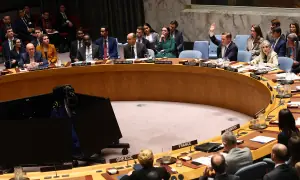
With ongoing violence in Gaza, the UN role has faced scrutiny for its perceived failure to halt Israel’s actions against Palestinians, largely due to the veto powers exercised by the US. Dr Callamard, however, insists that human rights organisations’ “legitimacy has never been higher because we are steadfast in holding the line”.
“We are committed to protecting civilians and advocating for necessary changes to adapt international law to the contemporary world.”
She also expressed gratitude to countries like Pakistan and South Africa for upholding international law and approaching the International Court of Justice and “reminding the world that there is something called international law that must be upheld”.
Watch the full interview on the DawnNews English YouTube channel
Published in Dawn, May 21st, 2024