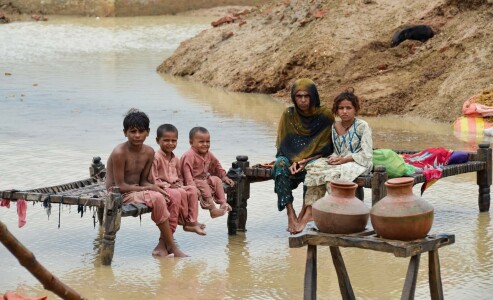
110 districts hit by floods as locals race to save Dadu


• 45pc of country’s cropland washed away, overall damages at $10bn
• Nearly 1,200 killed since June 14
• Johi, Mehar cut off from other areas
• Met Office predicts more rains, flash floods this month
DADU / ISLAMABAD: Sindh braced for yet more flooding on Thursday as a surge of water flowed down the Indus river, leaving parts of Dadu district inundated.
Meanwhile, Climate Change Minister Sherry Rehman told a summit that “monster” monsoon floods had washed away 45 per cent of country’s cropland, mainly in Sindh and caused around $10 billion in damages on the whole. In her estimation, around 70pc districts in the country are now under water. Overall, a third of Pakistan — or an area roughly the size of the UK — is inundated.
According to official data, the number of affected districts now stands at 110, including 34 in Balochistan, 33 in Khyber Pakhtunkhwa, 16 in Sindh and the rest in Punjab, Gilgit-Baltistan and Azad Kashmir.
In Dadu, with Khairpur Nathan Shah city already submerged, residents of Johi and Mehar were racing against time to protect their cities.
The 50,000 citizens of Johi and 10,000 flood-affected people who have come here from various flood-hit villages are under threat as water level was rising along with the ring embankment in Johi city.
Read: Pakistan's history of disasters and the lessons we fail to learn
Tariq Rind, a resident of Johi, told Dawn that 600 villages of Dadu district had been submerged and many people were stranded amid a shortage of boats. They are also faced with food and water scarcity.
To reduce pressure on the embankments of Johi and Dadu cities, the irrigation department has made a 1,000-foot-wide cut at the MNV drain close to Manchhar lake.
Men, women and children have gathered to work shifts to form new dikes and reinforce existing ones using sandbags, stones and other materials. Apart from fellow residents, songs blaring from loudspeakers are a major morale booster for those working tirelessly to put anything in the way of water ready to swallow vast swathes of the landscape.
Death toll hits 1,191
The floods have killed at least 1,191 people, including 399 children, with 21 deaths reported in the last 24 hours.
The Met Office has predicted even more rains and flash floods this month. “Overall, a tendency for normal to above normal precipitation is likely over the country during September,” it said in a monthly outlook released on Thursday.
The military said on Thursday it had evacuated some 50,000 people, including 1,000 by air, since rescue efforts began.
“We’re on a high alert as water arriving downstream from northern flooding is expected to enter the province over the next few days,” Sindh provincial government spokesman Murtaza Wahab told Reuters news agency.
He said a flow of some 600,000 cubic feet per second was expected to swell the Indus, testing its flood defences.
Under 10 feet of water
In Khairpur Nathan Shah, the water level has risen to 10 feet, leaving thousands of families homeless. Residents were roaming from one place to another place in search of food, according to Hafiz Amin Jamali, the president of the local citizens’ action committee.
With the Indus Highway submerged, Mehar has also been cut off from other areas. Residents continued to raise the ring embankment level to protect the city.
“We have been working to make and reinforce this dike since early morning,” Damshad Ali, 20, told Reuters, vowing to stay in the flood-stricken area with his family.
Read: How current calamity compares to 2010 floods
Nearby, another man called for help. “I appeal to all young men to come join the dike strengthening, God willing we will save the city of Mehar from the floodwaters,” he said from a mound of sandbags as local residents joined the effort. Dadu city is also under threat from four sides.
45pc cropland washed away
The government on Thursday said “monster” monsoon floods had washed away 45pc of the country’s cropland, mainly in Sindh and caused $10bn in damages.
Federal Minister for Climate Change Sherry Rehman shared the figures at a summit jointly held by her ministry and Unicef in Islamabad to brief young leaders on the country’s vulnerability due to climate change.
She said Sindh was the food basket of the country and its 45pc area was washed away due to heavy flooding, which would bring economic shocks in the future.
“My generation had the carbon-intensive lifestyle and you will have to define at one level what we have to change in our life,” she told the young participants.
“No such environmental and humanitarian crisis has occurred before and we should consider this as the decade’s major climate event. As 70pc of Pakistan’s (districts) are underwater because of a climate catastrophe, make no mistake that it’s all man-made disaster and it will not go back automatically,” she said.
“Our folklore and songs had been on monsoon season, which used to be of two to three spells, but this is a monster flood. Our helicopters could not get off the ground due to persistent rainfall and inclement weather,” she said.
Published in Dawn, September 2nd, 2022