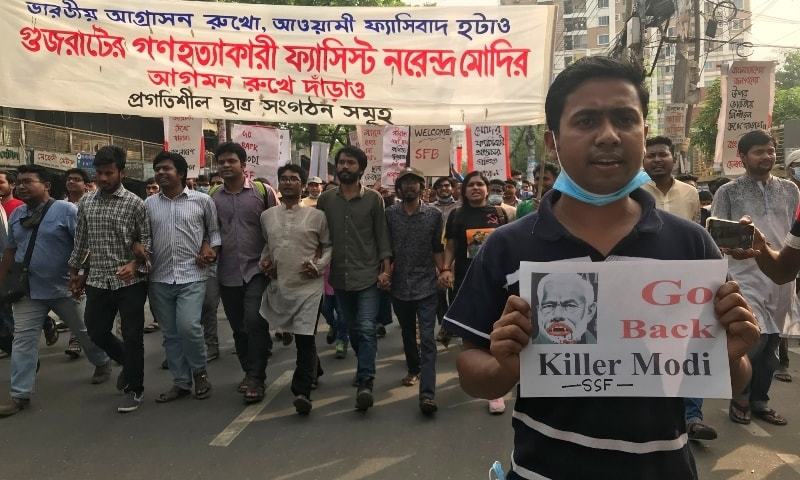
Four people killed in Bangladesh during protests against Modi's visit: police

At least four people were killed in the Bangladeshi city of Chittagong on Friday after police fired at protesters during a demonstration against a visit by Indian Prime Minister Narendra Modi, police officials said.
“We had to fire teargas and rubber bullets to disperse them as they entered a police station and carried out extensive vandalism,” Rafiqul Islam, the police official told Reuters, referring to protesters.
Modi arrived in the capital Dhaka for a two-day visit to celebrate the 50th anniversary of Bangladesh’s independence.
The protesters in Chittagong were from the Hefazat-i-Islam Bangladesh, an Islamist group opposed to the visit of Modi, who critics say has been pushing a Hindu-first agenda in India.
Mohammad Alauddin, another police official in Chittagong, said that eight people were brought to a hospital in the city with gunshot wounds, of which four succumbed to their injuries
Protests also flared in the capital Dhaka, where dozens of people, including two journalists, were injured in clashes with police, witnesses said.
The protests have continued since Thursday when police fired rubber bullets and tear gas at hundreds of mainly student demonstrators.
Police had said the protests got out of hand as demonstrators marched in Dhaka, with many throwing rocks and stones at officers, injuring at least four.
“We fired tear gas and rubber bullets to disperse them. There were 200 protesters. We have also arrested 33 people for violence,” police official Syed Nurul Islam had told AFP.
A spokesperson for the march had said 2,000 mainly student protesters joined the demonstration.