12
12
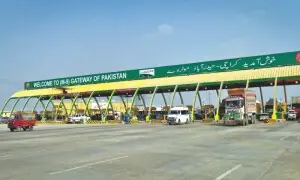
THE decision to establish markets along Pakistan’s borders with Afghanistan and Iran to boost trade underscores our weak economic relationship with our neighbours, apart from China. This is in spite of Pakistan’s strategic location in the region and its links through surface routes with India in the east, and Afghanistan and Iran in the west. Moreover, across Afghanistan are the Central Asian Republics. And we continue to have a significantly large untapped market beyond India. Unfortunately, the share of Pakistan’s intra-regional trade has declined in the last 10 years with exports to neighbouring countries falling from 12.2pc of its total overseas shipments in 2011 to 7.4pc in 2018. Similarly, Pakistan’s regional imports have dropped from 7.4pc of its total global purchases to 4.7pc during the same period.
Numerous historical factors, political disputes, security issues and trade barriers have hampered regional trade integration. In the east, the Kashmir dispute has prevented Islamabad and New Delhi from establishing deeper trade ties. In effect, Pakistan doesn’t enjoy comfortable trade relations with any South Asian nation with the exception of Sri Lanka. In India’s case it is no different. The adversarial relations between India and Pakistan have effectively buried the dream of a free-trade area in South Asia. In the west, Afghanistan has been an important trade partner. Yet bilateral trade remains much below its actual potential because of Afghanistan’s internal security conditions as well as a huge trust gap between the two states. Islamabad’s refusal to extend transit trade rights to India and Afghanistan owing to security and other reasons is reciprocated by Kabul’s refusal to allow us access to Central Asia through its territory, sealing the fate of an east-west trade corridor connecting South Asia with the Central Asian Republics. The only way for Pakistan to trade with Central Asia is through China, a route that remains closed five months of the year because of harsh weather. With Iran under US-sponsored sanctions, it has become impossible to develop strong, formal trade ties with Tehran.
Intra-regional trade plays a key role in the economic development and competitiveness of countries and is directly linked with their GDP growth rates. Take the example of EU and the Southeast Asian and East Asian economies. EU regional trade constitutes 65pc of the bloc’s international trade. In East Asia this ratio is 35pc and in Southeast Asia 25pc, compared to 5pc in South Asia. According to World Bank data, intra-regional trade accounts for about 1pc of South Asia’s GDP compared to almost 11pc for East Asia and the Pacific. It is absurd to expect that Pakistan alone can dismantle the trade barriers that limit regional economic growth. All stakeholders should work towards regional cooperation and learn from the experiences of other trading blocs. The increase in regional economic integration will lead to greater interdependence and faster growth, and ultimately create a strong constituency for peace across the region.
Published in Dawn, September 19th, 2020