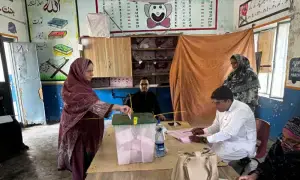
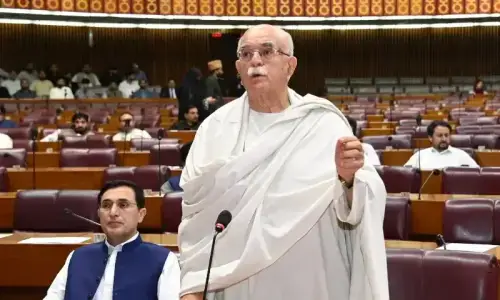
GILGIT-BALTISTAN will hold elections on Aug 18, 2020, for the Legislative Assembly’s 24 constituencies. The government’s five-year term ended on June 24. The Gilgit-Baltistan Empowerment and Self-Governance Order of 2009 divides the administration of the region into the Gilgit-Baltistan Legislative Assembly and the Gilgit-Baltistan Council. The reform package grants some legislative powers to the Assembly but most of the important subjects of legislation remain with the Council that has come under considerable criticism by locals. The latter consider it a powerful unelected body with the prime minister of Pakistan as its chairman.
The tenure of Hafiz Hafeezur Rehman of the PML-N as chief minister was generally peaceful. No major incident of violence occurred when compared to previous PPP rulers under whom GB saw sporadic violence from 2012 to 2014. However, the PML-N government came under sharp criticism by human rights and political activists as it sought to curb free speech and a free press. The government was blamed for taking harsh and coercive measures against local journalists and political activists as well as accused of silencing critical voices by including the names of some individuals in the Fourth Schedule of the Anti-Terrorism Act and sending others behind bars in unproven cases.
The upcoming elections will be held under challenging circumstances with Covid-19 having taken a heavy toll on an already under-resourced region. GB is dependent on the centre for monetary resources. Its health system is overwhelmed and under immense pressure because of the shortage of medical equipment. The outgoing chief minister has criticised Islamabad for not providing funds for GB’s fight against the pandemic.
The internal dynamics of GB need scrutiny. A majority of the youth population is critical of the federal government and has demanded real empowerment of locally elected leaders, autonomy in local administration and the political integration of GB with the Pakistani state. Successive governments have tried to address the problem through reform orders. But the locals have described these measures as cosmetic.
GB’s youth will play a decisive role in next month’s elections.
GB youth have a long history of political struggle, for instance, against the colonial-era of the Frontier Crimes Regulation and the feudal system. Various political organisations were established by the youth from the 1950s to 1970s. Many migrated to study or work in cities, mainly Karachi and Rawalpindi. In these cities, the Gilgit-Baltistan United Organisation, the GB Action Committee, the Ladakh Baltistan Muttahida Mahaz, the GB Students’ Federation, the Idara Taraqqi-i-Hunza and many others were formed. Students used these platforms to demand political rights for the people of GB, the abolition of the FCR and the end of feudal rule. Within the region, organisations such as the Gilgit League and the Tanzeem-i-Millatwere founded against the FCR and to demand political rights.
Compared to the provinces, GB has an exceptionally high literacy rate. Many students who study in universities of other cities — owing to the lack of higher education opportunities within the region — are currently in their native towns and villages. The pandemic and the ensuing closure of education institutes across Pakistan sent a majority of them back to their homes. Exposed to a metropolitan life, and having a modern education, their vote is going to play a decisive role. The youth’s support for the indigenous leadership of GB is growing. In Ghizer and Hunza, nationalist leaders Nawaz Khan Naji and Baba Jan have great influence among the youth. The way the authorities are handling Baba Jan’s case has increased his popularity.
Baba Jan was convicted for participating in political riots in 2011. He was acquitted in 2013 by a civil court of Gilgit but remanded again on charges of promoting anti-government sentiments and sentenced to 71 years imprisonment by an anti-terrorism court. In 2015, he contested local elections from jail, bagging the second highest number of votes, more than the candidates of mainstream national parties such as the PPP and PTI. Hunza’s youth played a pivotal role in Jan’s election campaign.
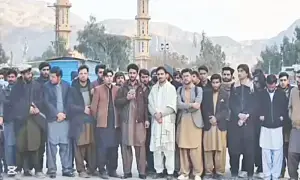
As GB heads towards polls, the Awami Action Committee — an alliance of 22 religious, civil and political parties — is drawing attention to key issues such as the Land Reform Act, compensation for small business owners due to the pandemic, etc. Students are demonstrating for access to internet services so that they can study. The PPP and PML-N have completed their terms. GB’s upcoming elections will answer two questions: will the PTI make inroads in GB’s politics, and to what extent will the youth’s swing vote shape GB’s future political course?
The writer teaches at the social sciences and liberal arts department of IBA.
Twitter: @saj_ahmd
Published in Dawn, July 8th, 2020